
Last reviewed: October 2026 by Dr. Farrukh Mehmood, Ph.D., 16+ years in pharmaceutical QC/QA
Key takeaways
- HPLC (high-performance liquid chromatography) separates the components of a mixture by pumping a liquid mobile phase at high pressure through a column packed with a stationary phase.
- Each component is retained for a different time (its retention time) depending on how strongly it interacts with the stationary phase. A detector turns the separated components into peaks on a chromatogram.
- A typical system has six parts: solvent reservoir, pump, injector or autosampler, column (in an oven), detector and data system.
- Reverse-phase HPLC, with a non-polar C18 or C8 column and a water–organic mobile phase, is used for most pharmaceutical assays and impurity tests.
- Every run must pass system suitability (precision, tailing, resolution, plate count) before the results can be used.
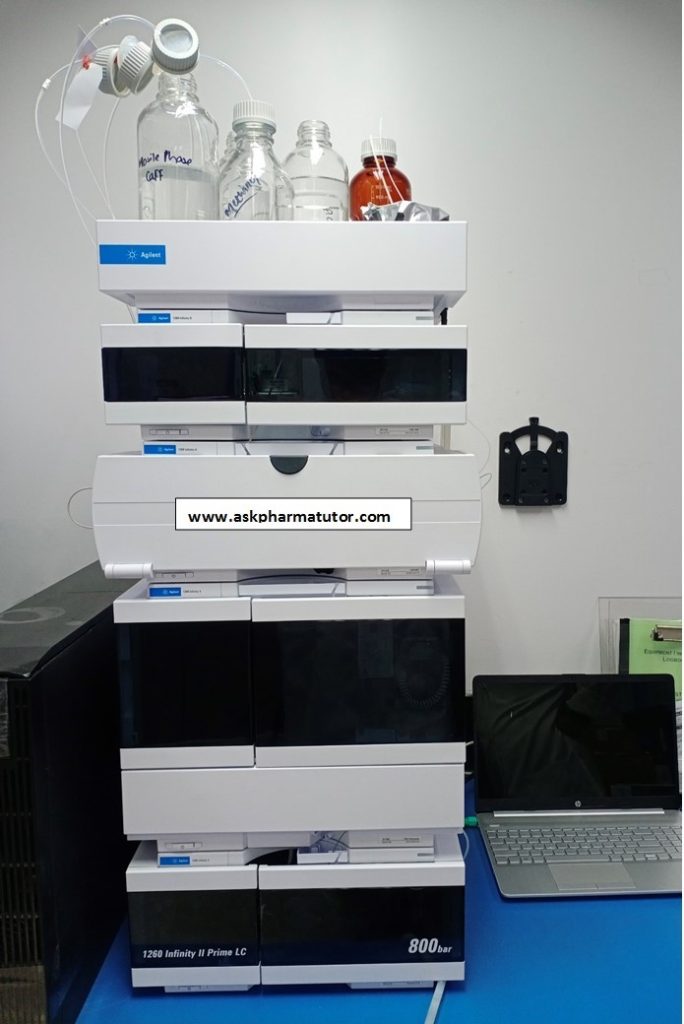
HPLC is the most widely used analytical technique in pharmaceutical quality control. It is used for assay, impurities, dissolution, content uniformity and stability testing. This guide explains how HPLC works, what each part of the system does, the main separation modes, the key terms on a chromatogram and how system suitability is judged. It finishes with a practical checklist for choosing an HPLC system. The photos are from a working QC laboratory.
What is HPLC?
Chromatography separates the components of a mixture between two phases: a stationary phase that stays in place, and a mobile phase that moves through it. In HPLC the stationary phase is made of very small particles (typically 2–5 µm) packed into a steel column. The mobile phase is a liquid that a pump forces through the column at high pressure. The small particles give sharp, well-separated peaks, and the high pressure is needed to push liquid through such a tightly packed bed.
HPLC suits compounds that are non-volatile or would decompose when heated. That includes most drug substances, excipients and degradation products. Gas chromatography (GC) is used instead for volatile compounds such as residual solvents.
How HPLC works: the principle
When the sample is injected, each component distributes itself between the mobile phase and the stationary phase. A component that interacts more strongly with the stationary phase spends more time held in the column and elutes later. A component that prefers the mobile phase travels faster and elutes earlier. Because each compound has a different balance of interactions, the components leave the column at different times. As they pass through the detector, each one produces a peak.
The time from injection to the top of a peak is the retention time, which helps identify the compound. The peak area is proportional to the amount of the compound, and is used for quantification against a reference standard.
| Term | Meaning |
|---|---|
| Retention time (tR) | Time from injection to the peak maximum. Used to identify the compound. |
| Dead time (t0) | Time for an unretained compound to pass through the column. |
| Retention factor (k) | (tR − t0) ÷ t0. How strongly a compound is retained. |
| Resolution (Rs) | How well two neighbouring peaks are separated. Baseline separation needs Rs of about 1.5 or more. |
| Tailing factor (T) | Peak symmetry. 1.0 is perfectly symmetrical; values above 1 mean the peak tails. |
| Theoretical plates (N) | Column efficiency. Higher N means narrower, sharper peaks. |
Main parts of an HPLC system
1. Solvent reservoir and degasser
The mobile phase is held in glass bottles, usually on top of the stack. Solvent lines with inlet filters carry it to the pump. An in-line degasser removes dissolved air, which would otherwise form bubbles in the pump or detector and cause pressure fluctuations and baseline noise. Mobile phases are filtered (typically through a 0.45 µm membrane) and buffers are made fresh.

2. Pump
The pump delivers the mobile phase at a constant, pulse-free flow rate, typically 0.5–2.0 mL/min on a 4.6 mm column. The back-pressure depends on the flow rate, column length, particle size, mobile phase viscosity and temperature. Conventional HPLC systems are usually rated to about 400–600 bar. UHPLC systems, built for sub-2 µm particles, are rated above 1,000 bar.
- Isocratic pump: one pre-mixed mobile phase.
- Binary pump: mixes two solvents at high pressure. It is accurate for gradients and has a small dwell volume.
- Quaternary pump: mixes up to four solvents at low pressure, which is flexible for method development.
3. Injector or autosampler
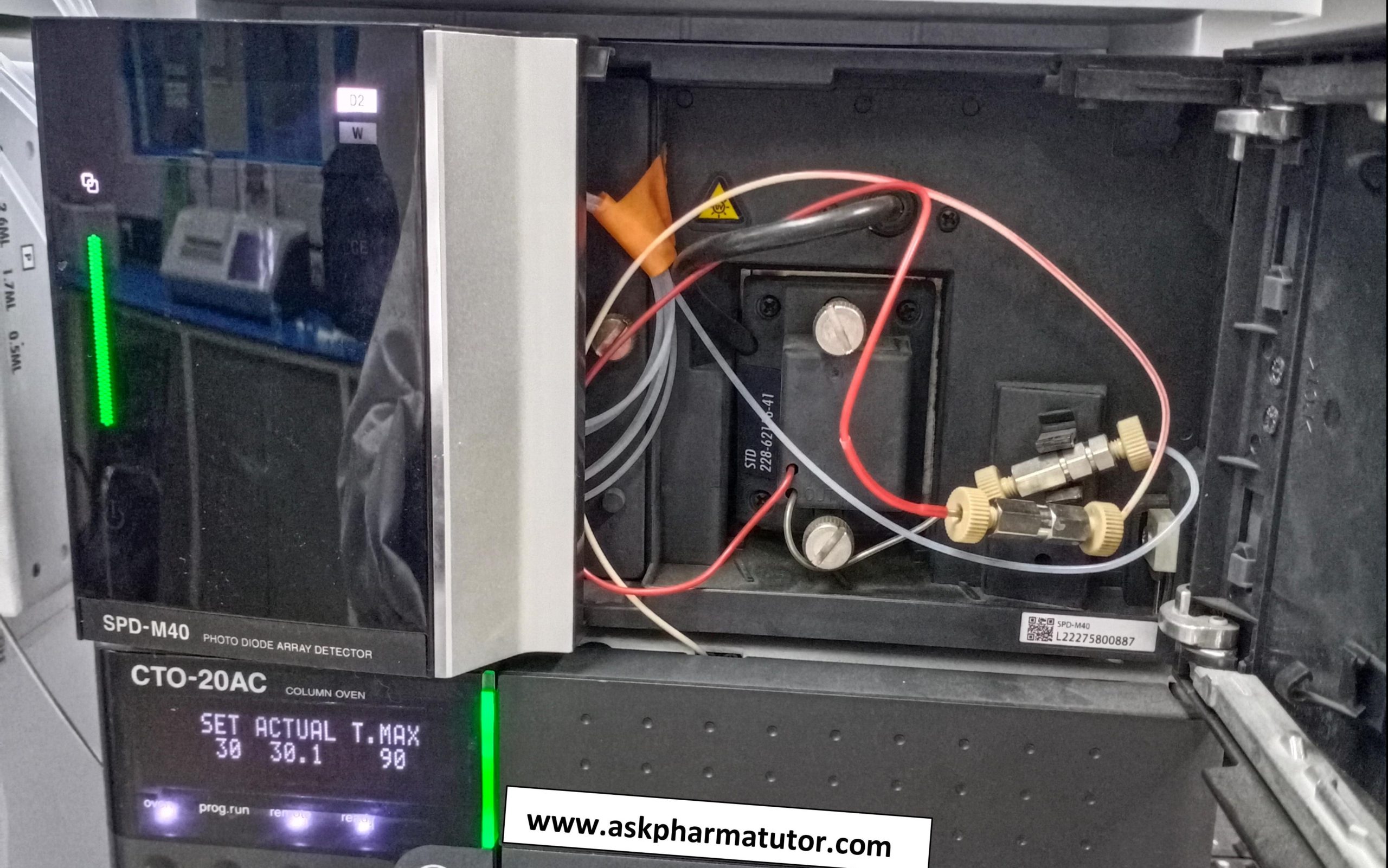
The injector introduces a precise volume of sample into the flowing mobile phase without stopping the flow. Modern QC laboratories use autosamplers, which run whole sequences of vials unattended and can keep samples cooled. Typical injection volumes are 1–100 µL. The precision of replicate injections is one of the system suitability checks.
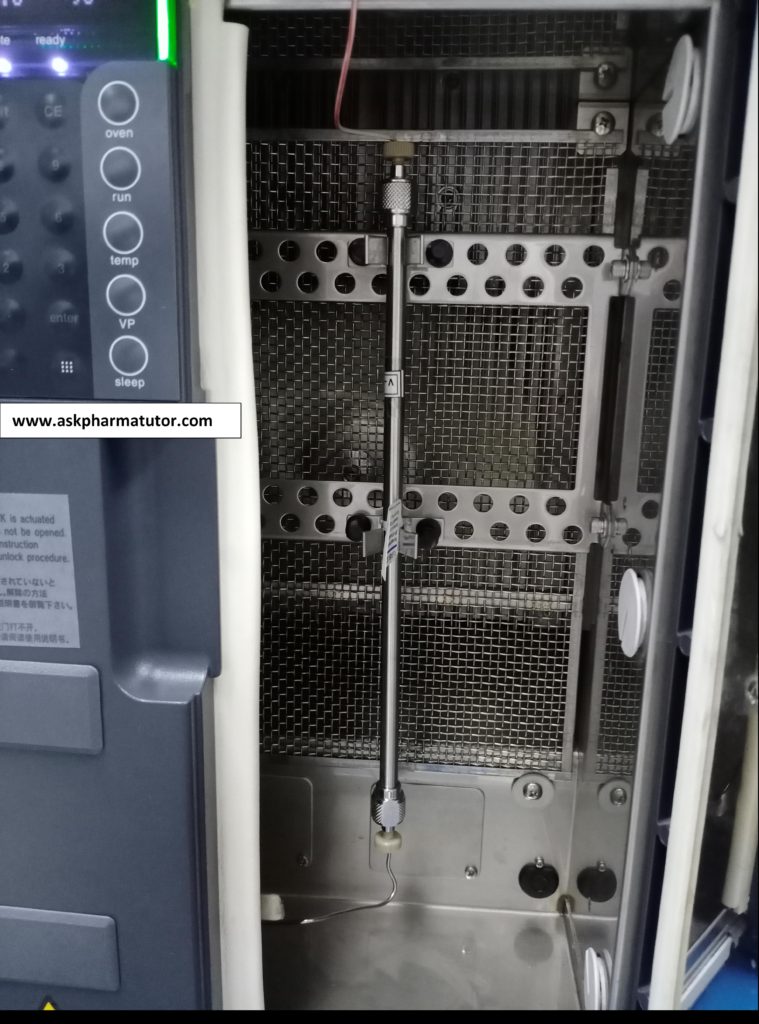
4. Column and column oven
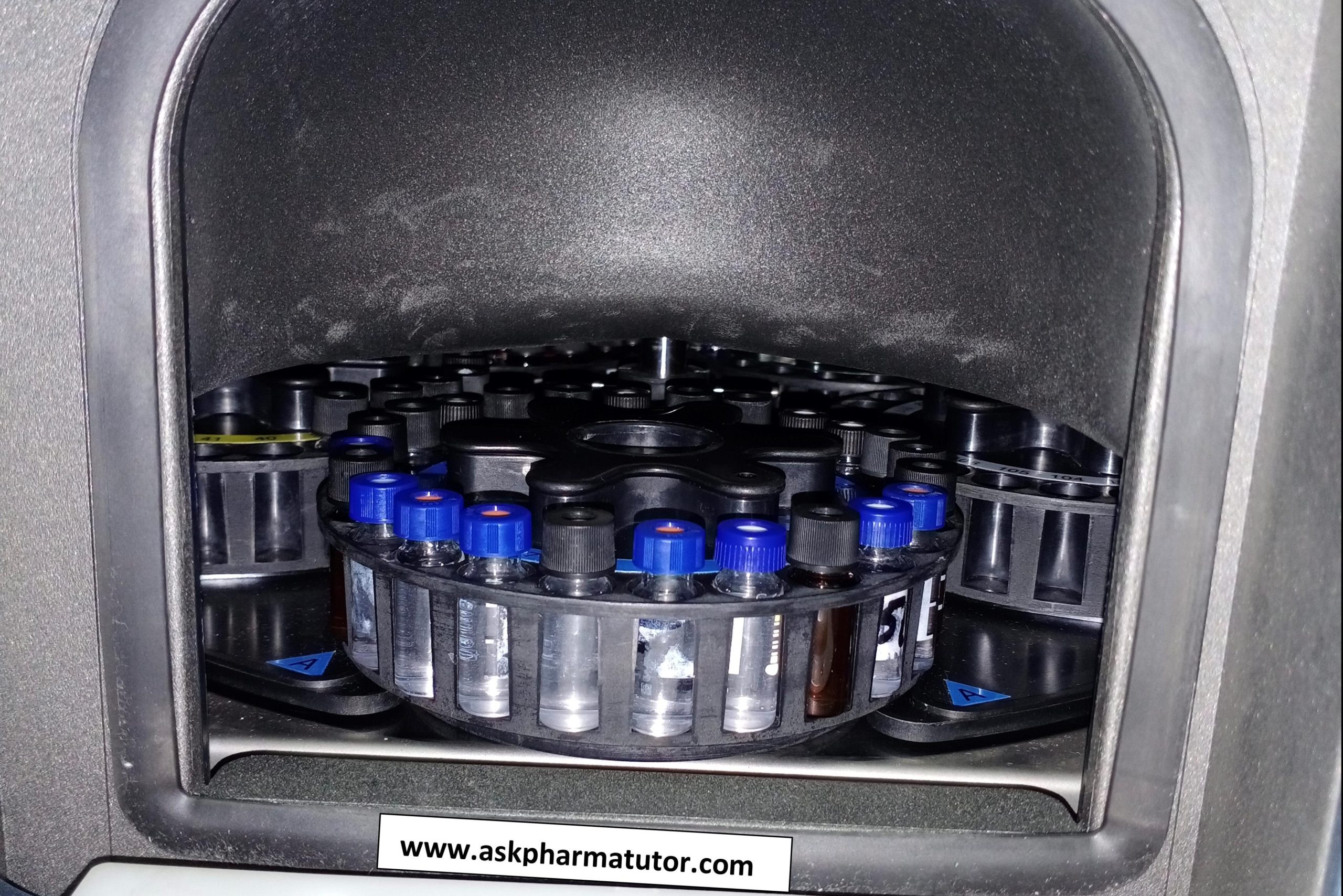
The column is where the separation happens, which is why it is often called the heart of the system. It is a stainless steel tube packed with the stationary phase. A typical pharmaceutical QC column is 150 × 4.6 mm with 3–5 µm particles. A guard column before it protects it from particles and strongly retained material. The column oven keeps the temperature constant (for example 30 °C), because retention times change with temperature.
| Column type | Typical internal diameter | Typical length | Used for |
|---|---|---|---|
| Analytical (conventional) | 4.6 mm (3.0–4.6 mm) | 50–250 mm | Routine QC assays and impurities |
| Narrow-bore / UHPLC | 2.1 mm | 50–150 mm | Fast methods, LC-MS, lower solvent use |
| Semi-preparative | about 10 mm | 100–250 mm | Isolating small amounts of impurities |
| Preparative | 20 mm or more | 100–250 mm | Purifying larger quantities |
5. Detector
The detector measures the components as they leave the column. Which one you use depends on the compound:
| Detector | Measures | Typical use |
|---|---|---|
| UV-Vis (variable wavelength) | Absorbance at a set wavelength | Most pharmaceutical assays and impurity methods |
| Photodiode array (PDA/DAD) | The full UV spectrum of each peak | Peak purity, identification, method development |
| Fluorescence (FLD) | Light emitted after excitation | Very sensitive and selective for fluorescent compounds |
| Refractive index (RI) | Change in refractive index | Compounds without a chromophore, such as sugars (isocratic only) |
| ELSD / CAD | Light scattering or charge from dried particles | Non-volatile compounds without UV absorbance; works with gradients |
| Mass spectrometer (LC-MS) | Mass-to-charge ratio | Identifying unknown impurities, very low levels |
| Electrochemical / conductivity | Oxidation-reduction current, or conductivity | Electroactive compounds; ions in ion chromatography |
6. Data system
Chromatography data software (CDS) controls the instrument, acquires the signal, integrates the peaks and calculates the results. In a GMP laboratory it must have user access control, electronic records and an audit trail that meets data integrity expectations (21 CFR Part 11 and EU GMP Annex 11).
Types of HPLC by separation mode
| Mode | Stationary phase | Mobile phase | Elution order | Typical use |
|---|---|---|---|---|
| Reverse phase (RP) | Non-polar (C18, C8, phenyl) | Water or buffer with methanol or acetonitrile | Polar compounds first, non-polar later | Most drug assays, impurities, dissolution |
| Normal phase (NP) | Polar (silica, cyano, amino) | Non-polar organic (hexane, ethyl acetate, IPA) | Non-polar first, polar later | Isomers, lipophilic compounds, some chiral methods |
| HILIC | Polar (silica, amide) | Mostly acetonitrile with a little aqueous buffer | Non-polar first, polar later | Very polar compounds poorly retained on C18 |
| Ion exchange | Charged groups (cation or anion exchanger) | Aqueous buffer; pH and ionic strength control elution | By charge | Ions, amino acids, proteins |
| Size exclusion (SEC) | Porous particles with controlled pore size | Aqueous or organic, no interaction intended | Large molecules first, small later | Polymers, protein aggregates |
| Chiral | Chiral selector (e.g. polysaccharide) | NP or RP | By enantiomer | Enantiomeric purity |
Reverse phase dominates pharmaceutical analysis. It works for compounds across a wide range of polarity, its water-based mobile phases are robust and reproducible, and C18 columns from many suppliers are well characterised.
Isocratic vs gradient elution
| Isocratic | Gradient | |
|---|---|---|
| Mobile phase | Constant composition throughout the run | Organic content increases during the run |
| Best for | Simple samples with a few peaks, such as an assay | Complex samples with a wide polarity range, such as related substances |
| Peaks | Late peaks get broad and flat | Late peaks stay sharp; shorter total run time |
| Equipment | Any pump | Binary or quaternary pump; re-equilibration needed between runs |
Typical method parameters
Every method specifies its own conditions. As an example, a typical reverse-phase assay method might use:
| Parameter | Example setting |
|---|---|
| Column | C18, 150 × 4.6 mm, 5 µm |
| Mobile phase | Phosphate buffer pH 3.0 : acetonitrile (60:40), isocratic |
| Flow rate | 1.0 mL/min |
| Column temperature | 30 °C |
| Detection | UV at the compound’s absorbance maximum (e.g. 254 nm) |
| Injection volume | 10–20 µL |
| Run time | Long enough to elute all peaks of interest, often about twice the main peak’s retention time |
Compendial methods allow only limited adjustments to these conditions without revalidation (see USP <621>). Any other change must be validated. See our method validation guide (ICH Q2).
System suitability
Before sample results can be used, the system must show that it is performing as the method requires on the day. System suitability is tested with standard injections at the start of the sequence and often during and after it. The method or monograph sets the limits. Typical criteria for an assay are:
| Parameter | What it shows | Typical criterion |
|---|---|---|
| %RSD of replicate standard injections | Injection and system precision | NMT 2.0% (often 5 or 6 injections), or as specified |
| Tailing factor | Peak symmetry | NMT 2.0 |
| Resolution | Separation of the critical pair | As specified, commonly NLT 1.5–2.0 |
| Theoretical plates | Column efficiency | As specified, e.g. NLT 2000 |
Check replicate injections with the free RSD calculator, and calculate results with the HPLC assay calculator. If system suitability fails, the run must not proceed. Our HPLC troubleshooting guide includes a step-by-step decision tree.
Common HPLC problems at a glance
| Symptom | Usual first suspects |
|---|---|
| High back-pressure | Blocked in-line filter, guard column or column frit; precipitated buffer |
| Low or fluctuating pressure | Air in the pump, leaking fitting, worn pump seal or check valve |
| Ghost or extra peaks | Carryover, contaminated mobile phase or diluent |
| Tailing or split peaks | Column void or contamination, wrong mobile phase pH, sample solvent too strong |
| Noisy or drifting baseline | Air bubbles, dirty flow cell, ageing lamp, poor temperature control |
| Retention time shift | Mobile phase composition or pH error, flow rate, column temperature, column ageing |
Applications of HPLC
- Pharmaceutical QC: assay of drug substances and products, related substances and degradation products, dissolution, content uniformity, stability studies, and cleaning validation swab analysis.
- Research and development: method development, forced degradation, impurity isolation (preparative HPLC) and identification (LC-MS).
- Clinical and bioanalysis: drug levels in plasma, therapeutic drug monitoring.
- Food and environment: preservatives, sugars, vitamins, mycotoxins, pesticides and pollutants in water.
- Forensics: drugs of abuse and toxicology screening.
Advantages and limitations
| Advantages | Limitations |
|---|---|
| High resolution: separates closely related compounds and impurities | Instruments, columns and HPLC-grade solvents are expensive |
| Accurate and precise quantification | Needs trained analysts for setup, troubleshooting and data review |
| Works for non-volatile and heat-sensitive compounds | Co-elution can hide impurities unless the method is specific |
| Small sample volumes; fully automated sequences | Generates solvent waste |
| Well accepted by pharmacopoeias and regulators | Compounds without a chromophore need special detectors |
Buying an HPLC: what to check
If you are choosing a system for a QC or R&D laboratory, start from the methods you need to run, not from the brochure.
- Methods and pressure: conventional HPLC (around 400–600 bar) runs most compendial methods. Choose UHPLC only if you will run sub-2 µm or fast methods.
- Pump type: isocratic for simple assays only. Binary or quaternary if you need gradients (most impurity methods do).
- Detector: UV-Vis for routine work. Choose a PDA if you need peak purity or spectra. Add FLD, RI or ELSD/CAD only if your products need them.
- Autosampler: vial capacity, injection range and precision, and sample cooling for unstable solutions.
- Column oven: temperature range and the number of columns it holds.
- Software and data integrity: audit trail, user roles, electronic signatures and network storage, to meet Part 11 and Annex 11.
- Qualification and service: IQ/OQ/PQ documentation, local engineers, spare parts availability and response time.
- Method transfer: compatibility with the systems your partners, contract labs or regulators use. Dwell volume matters for gradient methods.
- Total cost of ownership: the price, plus columns, lamps, seals, solvents, service contracts and software licences over the instrument’s life.
The major manufacturers each offer conventional and UHPLC platforms with their own data systems:
- Agilent: the 1260 and 1290 Infinity II/III series, with OpenLab CDS.
- Waters: Alliance and ACQUITY systems, with Empower.
- Shimadzu: the Nexera and i-Series, with LabSolutions.
- Thermo Fisher Scientific: the Vanquish series, with Chromeleon.
Compare current models and local service support with each supplier.
Frequently asked questions
What is the difference between HPLC and UHPLC?
UHPLC uses columns with sub-2 µm particles and instruments rated to much higher pressure (over 1,000 bar). This gives faster runs and sharper peaks. Conventional HPLC uses 3–5 µm particles and runs most existing pharmacopoeial methods.
Why is reverse-phase HPLC used most in pharma?
It works for compounds across a wide range of polarity, uses robust water-based mobile phases, gives reproducible retention, and C18 columns are widely available and well characterised.
How is HPLC different from GC?
HPLC uses a liquid mobile phase and suits non-volatile or heat-sensitive compounds. GC uses a gas mobile phase and a heated column, and suits volatile compounds such as residual solvents.
How long does an HPLC column last?
It depends on the samples, the mobile phase pH and how well the column is cared for. Many laboratories track the number of injections and replace the column when system suitability starts to fail. A guard column, filtered samples and proper flushing after buffer use all extend column life.
Related guides and tools
- HPLC troubleshooting guide: common problems and solutions
- Method validation guide (ICH Q2)
- OOS procedure in pharma
- Stability studies (ICH Q1A)
- HPLC assay calculator
- RSD calculator
- Measurement uncertainty calculator (pH and HPLC assay)
References
- USP General Chapter <621> Chromatography.
- Ph. Eur. 2.2.46 Chromatographic separation techniques.
- ICH Q2(R2) Validation of Analytical Procedures.
- Snyder LR, Kirkland JJ, Dolan JW. Introduction to Modern Liquid Chromatography, 3rd edition. Wiley, 2010.
Working in a QC lab? Our complete guide to HPLC in pharmaceutical QC covers system suitability under USP <621>, method validation under ICH Q2(R2), worked calculations and data integrity.
