
Last reviewed: November 2026 by Dr. Farrukh Mehmood, Ph.D., 16+ years in pharmaceutical QC/QA
Key takeaways
- A pharmaceutical QC microbiology lab answers one question: is this material or product microbiologically fit for use?
- For non-sterile products, the core tests are microbial enumeration (TAMC and TYMC, USP <61>) and tests for specified microorganisms (USP <62>), judged against the limits in USP <1111>.
- Every result depends on three foundations: culture media that pass the growth promotion test, correct serial dilutions, and a method shown to be suitable for that product.
- Limits written as powers of ten are read generously: a limit of 103 CFU/g allows counts up to 2,000 CFU/g.
- This page links every QC microbiology guide, calculator, quiz and template on AskPharmaTutor in the order a lab uses them.
The QC microbiology lab is where a batch of tablets, syrup, cream or raw material is checked for the bacteria, yeasts and moulds it may carry. A failing count can hold a batch, trigger an OOS investigation and delay release, so the lab has to be right, and has to be able to prove it. This guide maps the work of a pharmaceutical QC microbiology lab from the moment a culture medium arrives to the moment a result is reported, and points to a detailed AskPharmaTutor guide for each step. It is written from practice in regulated QC labs and is a learning aid: follow your approved SOPs and the current pharmacopoeia for routine work.
What a QC microbiology lab does
Most of the routine workload falls into five groups:
- Testing non-sterile products and raw materials: microbial counts and the absence of specified organisms, batch by batch.
- Preparing and qualifying culture media: every batch of media must show it can grow organisms before it is used.
- Testing utilities and the environment: purified water, compressed air, surfaces and air in production areas.
- Special tests: microbial assays of antibiotics, minimum inhibitory concentration, packaging materials, and for sterile products, sterility and bacterial endotoxins.
- Investigations: out-of-specification results, excursions and trends, with root cause and CAPA.
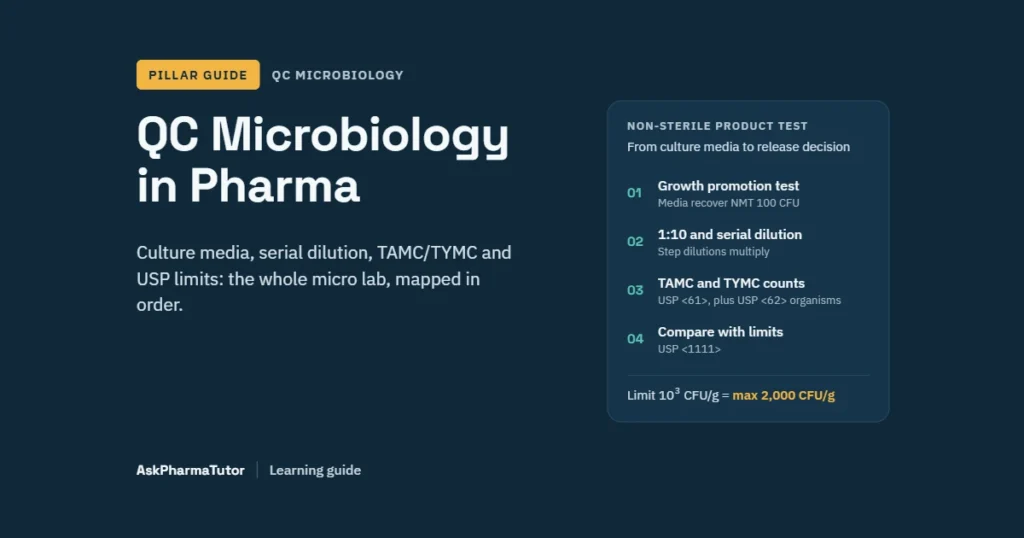
The diagram shows how these pieces connect for a typical non-sterile product test.
1. Culture media and the growth promotion test
A culture medium can look perfect and still fail to grow anything: overheating during sterilisation, the wrong pH or long storage all damage it. That is why every batch, whether prepared in-house or bought ready to use, must pass a growth promotion test (GPT) before it is used. The test inoculates the medium with not more than 100 CFU of each specified organism. On solid media the count must be within a factor of 2 of the inoculum (50–200%); liquid media must show clearly visible growth. Selective media are also checked for their inhibitory and indicative properties.
The test strains matter as much as the media. They must be not more than five passages from the reference culture, which is why labs keep a seed-lot system and record every passage.
Read next
Growth promotion test: organisms, procedure and acceptance criteria: the USP <61> and <62> organisms, a step-by-step table and a free GPT record template.
2. Sample preparation and serial dilution
Almost every count starts with a 1:10 dilution: 10 g or 10 mL of product in 90 mL of diluent. Products that do not mix with water need a surfactant such as polysorbate 80, and products with antimicrobial activity need neutralisation or dilution so that surviving organisms can grow. From there, tenfold serial dilutions bring the count into a range that can be counted on a plate.
Two rules prevent most errors. Step dilutions multiply, so three tenfold steps give 10−3, not 3/10. And each transfer needs a fresh pipette tip and thorough mixing, because carry-over inflates every count downstream.
Read next
Serial dilution: method, formulas and worked examples: dilution-factor table, diagram, four worked QC examples and a free serial dilution and CFU calculator.
3. Method suitability
Before a method is used routinely for a product, the lab must show that it can recover organisms in the presence of that product. Low numbers of each test organism are added to the prepared sample, and the recovered count must be within a factor of 2 of the count from a control without product. If recovery fails, the usual fixes are more dilution, a neutraliser in the diluent, membrane filtration with rinsing, or a combination. A method that has not passed suitability can report a clean result for a contaminated batch, which is the most dangerous kind of error in this lab.
4. Microbial enumeration: TAMC and TYMC
USP <61> (Ph. Eur. 2.6.12) gives two counts for non-sterile products:
| TAMC (total aerobic microbial count) | TYMC (total combined yeasts and moulds count) | |
|---|---|---|
| Medium | Soybean-Casein Digest Agar | Sabouraud Dextrose Agar |
| Incubation | 30–35 °C for 3–5 days | 20–25 °C for 5–7 days |
| Plates to count (pour plate) | Highest number of colonies below 250 | Highest number of colonies below 50 |
| Methods | Pour plate, spread plate, membrane filtration or most probable number (MPN) | |
The result is calculated as CFU per gram or millilitre: the mean count divided by the volume plated and the dilution of that tube. With 1 mL of the 1:10 dilution plated, multiply the mean count by 10.
Read next
Total microbial count test: TAMC and TYMC step by step: media, plating, the calculation and limits, with a free total microbial count checklist (PDF).
5. Tests for specified microorganisms
A low count is not enough on its own. Depending on the dosage form, the product must also be free of certain organisms that would be harmful by that route. USP <62> (Ph. Eur. 2.6.13) describes enrichment and selective tests for bile-tolerant gram-negative bacteria, Escherichia coli, Salmonella, Pseudomonas aeruginosa, Staphylococcus aureus, Clostridia and Candida albicans. A typical test enriches the sample in broth, subcultures onto a selective agar and confirms suspect colonies.
6. Acceptance criteria (USP <1111>)
USP <1111> (Ph. Eur. 5.1.4) sets the limits by route of administration. The most common ones are below; check the current chapter and your product specification before use.
| Route of administration | TAMC (CFU/g or mL) | TYMC (CFU/g or mL) | Specified organisms (absent) |
|---|---|---|---|
| Non-aqueous oral (tablets, capsules) | 103 | 102 | E. coli in 1 g or 1 mL |
| Aqueous oral (syrups, suspensions) | 102 | 101 | E. coli in 1 g or 1 mL |
| Rectal | 103 | 102 | None listed |
| Cutaneous (creams, ointments), oromucosal, nasal, ear | 102 | 101 | S. aureus, P. aeruginosa in 1 g or 1 mL |
| Vaginal | 102 | 101 | P. aeruginosa, S. aureus, C. albicans in 1 g or 1 mL |
| Inhalation | 102 | 101 | S. aureus, P. aeruginosa, bile-tolerant gram-negative bacteria |
Reading the limits: a limit written as a power of ten allows a maximum count of twice that value. A limit of 101 allows up to 20, 102 allows up to 200 and 103 allows up to 2,000. This is one of the most common points of confusion in audits and in interviews.
7. Microbial assays and antimicrobial testing
Some products are tested with microorganisms rather than for them. A microbial assay measures the potency of an antibiotic by comparing the zones of inhibition (or turbidity) it produces with those of a reference standard, for antibiotics whose biological activity cannot be measured reliably by chemical methods alone. The minimum inhibitory concentration (MIC) is the lowest concentration of an antimicrobial that prevents visible growth of a test organism, and is used in development, preservative studies and resistance work.
8. Primary packaging materials
Bottles, caps, blister foils and tubes touch the product directly, so their microbial quality is controlled too, usually by swab or rinse methods against a supplier specification. A clean product in a contaminated container is still a contaminated product.
Read next
Microbiological testing of primary packaging material: sampling, methods and acceptance criteria.
9. Water, environment, sterility and endotoxins
These areas complete the picture. Detailed AskPharmaTutor guides for each are in preparation; the essentials are:
- Pharmaceutical water: USP <1231> suggests action levels of 100 CFU/mL for purified water and 10 CFU/100 mL for water for injection. Trending matters more than single results.
- Environmental monitoring: settle plates, contact plates, active air sampling and personnel monitoring, with limits by cleanroom grade (EU GMP Annex 1 for sterile manufacturing).
- Sterility test (USP <71>): membrane filtration or direct inoculation, with Fluid Thioglycollate Medium at 30–35 °C and Soybean-Casein Digest Medium at 20–25 °C, incubated for 14 days.
- Bacterial endotoxins (USP <85>): the LAL test; water for injection is typically limited to 0.25 EU/mL.
10. When a result fails: OOS in the micro lab
Microbiology results are harder to investigate than chemistry results: a plate cannot be re-injected, and organisms grow or die between tests. A sound investigation checks the lab first (media GPT records, negative controls, incubator temperatures, analyst technique and the identity of the organism) before it looks at manufacturing. Identifying the organism to species level is often the key clue, because it points to its likely source: skin, water, raw material or the environment.
Read next
OOS procedure in pharma: phase I and phase II investigation, retesting rules and documentation.
Test yourself
Timed questions with an explanation for every answer:
- QC Microbiology Quiz: culture media, growth promotion, microbial counts and lab practice.
- Microbiology Quiz: core microbiology for pharmacy students.
Free downloads
Frequently asked questions
What tests does a pharmaceutical QC microbiology lab perform?
For non-sterile products: microbial enumeration (TAMC and TYMC) and tests for specified microorganisms. Around these sit growth promotion testing of media, method suitability, water and environmental monitoring, microbial assays and, for sterile products, sterility and bacterial endotoxin tests.
What is the difference between TAMC and TYMC?
TAMC counts aerobic bacteria (and any fungi that grow) on Soybean-Casein Digest Agar at 30–35 °C for 3–5 days. TYMC counts yeasts and moulds on Sabouraud Dextrose Agar at 20–25 °C for 5–7 days.
Why must every batch of culture media be tested?
Because a medium that cannot support growth produces false negatives: a contaminated product would pass. The growth promotion test proves each batch can recover low numbers of the specified organisms before it is used.
What does a limit of 10³ CFU/g mean?
Under USP <1111>, a limit of 103 CFU/g allows a maximum acceptable count of 2,000 CFU/g. The same rule applies across the table: 102 allows up to 200 and 101 up to 20.
Which pharmacopoeia chapters cover microbiological testing of non-sterile products?
USP <61> (enumeration), <62> (specified microorganisms) and <1111> (acceptance criteria). The harmonised European equivalents are Ph. Eur. 2.6.12, 2.6.13 and 5.1.4.
References
- USP General Chapter <61> Microbiological Examination of Nonsterile Products: Microbial Enumeration Tests.
- USP General Chapter <62> Microbiological Examination of Nonsterile Products: Tests for Specified Microorganisms.
- USP General Chapter <1111> Microbiological Examination of Nonsterile Products: Acceptance Criteria for Pharmaceutical Preparations and Substances for Pharmaceutical Use.
- USP General Chapters <71> Sterility Tests, <85> Bacterial Endotoxins Test and <1231> Water for Pharmaceutical Purposes.
- European Pharmacopoeia 2.6.12, 2.6.13 and 5.1.4.
- EudraLex Volume 4, EU GMP Annex 1: Manufacture of Sterile Medicinal Products (2022).
