
Last reviewed: November 2026 by Dr. Farrukh Mehmood, Ph.D., 16+ years in pharmaceutical QC/QA
Key takeaways
- TAMC and TYMC limits for non-sterile products come from USP <1111>, harmonised with Ph. Eur. 5.1.4 and the Japanese Pharmacopoeia.
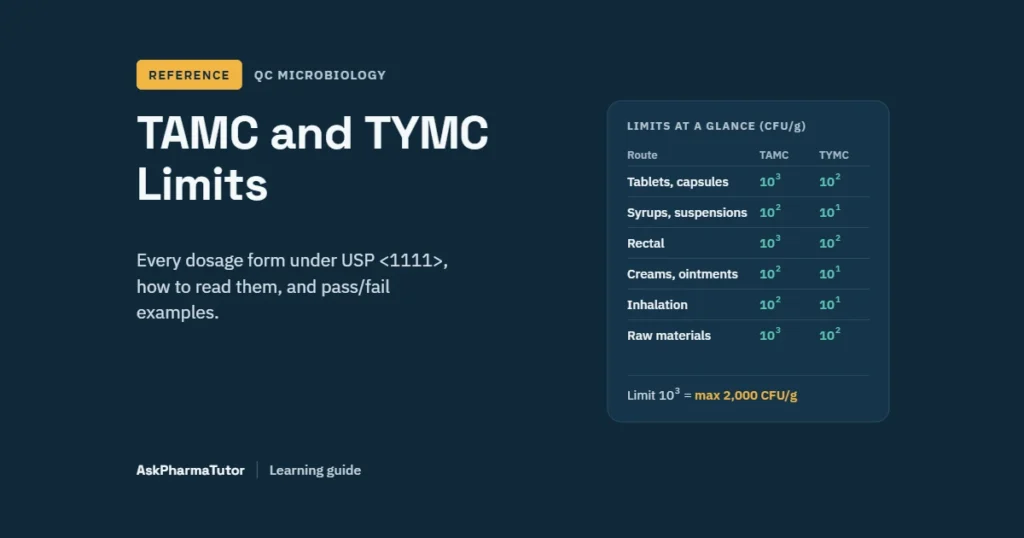
- Limits are set by route of administration: 103/102 CFU/g for non-aqueous oral and rectal products, 102/101 for almost everything else.
- A limit of 10n is not a maximum of 10n: 101 allows up to 20, 102 up to 200 and 103 up to 2,000.
- Fungi growing on the TAMC plate count as TAMC, and bacteria on the TYMC plate count as TYMC.
- The table is a minimum. Other organisms found in the product still need a risk assessment.
Every non-sterile batch tested in a QC microbiology lab ends with the same question: is the count within the limit? This page sets out the TAMC (total aerobic microbial count) and TYMC (total combined yeasts and moulds count) limits for each type of product, explains how to read them, and works through pass/fail examples. For how to run the test itself, see the total microbial count test guide.
Where the limits come from
Three harmonised pharmacopoeia chapters work together. USP <61> (Ph. Eur. 2.6.12) describes how to count TAMC and TYMC. USP <62> (Ph. Eur. 2.6.13) describes the tests for specified organisms such as E. coli. USP <1111> (Ph. Eur. 5.1.4) sets the acceptance criteria: the limits on this page. Your product specification and any individual monograph can set tighter or different limits, and those take priority for that product.
How to read a limit: 103 does not mean 1,000
Limits are written as powers of ten, and USP <61> and <1111> both say how to interpret them:
| Limit written as | Maximum acceptable count |
|---|---|
| 101 CFU | 20 |
| 102 CFU | 200 |
| 103 CFU | 2,000 |
| 104 CFU | 20,000 |
The factor of two allows for the variability of plate counts. A count of 1,800 CFU/g against a limit of 103 complies. A count of 2,100 CFU/g does not. Where replicate plates are counted, the result compared with the limit is their mean.
TAMC and TYMC limits by dosage form (USP <1111>)
Limits are in CFU per gram or per mL, except for transdermal patches, which are per patch.
| Route of administration | TAMC | TYMC | Specified organisms (absent) |
|---|---|---|---|
| Non-aqueous preparations for oral use (tablets, capsules, powders) | 103 | 102 | E. coli (1 g or 1 mL) |
| Aqueous preparations for oral use (syrups, suspensions, solutions) | 102 | 101 | E. coli (1 g or 1 mL) |
| Rectal use | 103 | 102 | None listed |
| Oromucosal use | 102 | 101 | S. aureus, P. aeruginosa (1 g or 1 mL) |
| Gingival use | 102 | 101 | S. aureus, P. aeruginosa (1 g or 1 mL) |
| Cutaneous use (creams, ointments, gels, lotions) | 102 | 101 | S. aureus, P. aeruginosa (1 g or 1 mL) |
| Nasal use | 102 | 101 | S. aureus, P. aeruginosa (1 g or 1 mL) |
| Auricular (ear) use | 102 | 101 | S. aureus, P. aeruginosa (1 g or 1 mL) |
| Vaginal use | 102 | 101 | P. aeruginosa, S. aureus, C. albicans (1 g or 1 mL) |
| Transdermal patches (per patch, including adhesive and backing) | 102 | 101 | S. aureus, P. aeruginosa (1 patch) |
| Inhalation use | 102 | 101 | S. aureus, P. aeruginosa, bile-tolerant gram-negative bacteria (1 g or 1 mL) |
Liquid preparations for nebulisation have additional requirements in USP <1111>. Check the current chapter before setting a specification.
Limits for raw materials (substances for pharmaceutical use)
For non-sterile substances for pharmaceutical use (active ingredients and excipients), the general limits are TAMC 103 CFU/g or mL and TYMC 102 CFU/g or mL, so a maximum of 2,000 and 200. No specified organisms are listed in the general table, but the individual monograph may add them. Excipients of natural origin, such as starches and gums, often carry their own microbial tests in the monograph, so always check it.
Ph. Eur. special provision for natural raw materials
Ph. Eur. 5.1.4 has an extra category that USP <1111> does not: oral dosage forms containing raw materials of natural (animal, vegetal or mineral) origin for which antimicrobial pre-treatment is not feasible. Where the competent authority accepts a raw-material TAMC above 103 CFU/g, the product limits are:
| Test | Limit |
|---|---|
| TAMC | 104 CFU/g or mL |
| TYMC | 102 CFU/g or mL |
| Bile-tolerant gram-negative bacteria | 102 CFU/g or mL |
| E. coli | Absent in 1 g or 1 mL |
| S. aureus | Absent in 1 g or 1 mL |
| Salmonella | Absent in 10 g or 10 mL |
Herbal medicinal products for oral use have their own Ph. Eur. chapter (5.1.8), with different limits.
What counts toward TAMC and TYMC
- TAMC is the count on Soybean-Casein Digest Agar (30–35 °C, 3–5 days). If fungi grow on this medium, they are counted as part of TAMC.
- TYMC is the count on Sabouraud Dextrose Agar (20–25 °C, 5–7 days). If bacteria grow on this medium, they are counted as part of TYMC.
- If bacteria on Sabouraud are expected to push the TYMC over its limit, USP <61> allows Sabouraud Dextrose Agar containing antibiotics. That is a method choice: show it is suitable for the product before routine use, rather than switching after a high result.
Pass or fail? Six worked examples
| Product and result | Limit | Maximum | Verdict |
|---|---|---|---|
| Tablet, TAMC 1,800 CFU/g | 103 | 2,000 | Complies |
| Tablet, TYMC 150 CFU/g | 102 | 200 | Complies |
| Syrup, TAMC 250 CFU/mL | 102 | 200 | Does not comply |
| Cream, TYMC 30 CFU/g | 101 | 20 | Does not comply |
| Transdermal patch, TAMC 90 CFU per patch | 102 per patch | 200 | Complies |
| Excipient, TAMC 2,400 CFU/g | 103 | 2,000 | Does not comply |
Two points from these examples. First, the same count can pass or fail depending on the route: a TYMC of 150 passes for a tablet (maximum 200) but would fail for a syrup or a cream (maximum 20). Second, a TAMC result alone is not a pass: the tablet also needs E. coli absent in 1 g, and the cream needs S. aureus and P. aeruginosa absent in 1 g.
For the calculations behind results like these, try the serial dilution problems with answers.
Beyond the table: other organisms
USP <1111> says the list of specified organisms is not exhaustive. Depending on the starting materials and the process, other organisms may need testing. When an organism is recovered that is not in the table, its significance is assessed against:
- the use of the product, which depends on the route (eye, nose, respiratory tract and so on)
- whether the product supports growth and has adequate preservation
- how it is applied
- who will use it: neonates, infants and debilitated patients are at higher risk
- use of immunosuppressive agents or corticosteroids
- disease, wounds or organ damage in the patient
This assessment is done by staff trained in microbiology. A low count of Burkholderia cepacia complex in an aqueous oral product, for example, can be unacceptable even when the TAMC complies.
When a result exceeds the limit
A count above the maximum is an out-of-specification result. Start with the lab: media growth promotion records, negative controls, incubator temperatures, the dilution calculation and analyst technique. Identify the organism, because its type often points to the source (skin, water, raw material or environment). Only then move to manufacturing. The OOS procedure guide covers phase I and phase II investigation and retesting rules.
Frequently asked questions
What are the TAMC and TYMC limits for tablets?
Under USP <1111>, non-aqueous oral preparations such as tablets and capsules have a TAMC limit of 103 CFU/g (maximum 2,000) and a TYMC limit of 102 CFU/g (maximum 200), with E. coli absent in 1 g.
What does a limit of 102 CFU/g mean?
It means a maximum acceptable count of 200 CFU/g. In the same way, 101 allows up to 20 and 103 allows up to 2,000.
Are fungi on the TAMC plate counted?
Yes. Under USP <61>, any fungi growing on Soybean-Casein Digest Agar are counted as part of TAMC, and any bacteria growing on Sabouraud Dextrose Agar are counted as part of TYMC.
What are the microbial limits for raw materials?
The general USP <1111> limits for non-sterile substances for pharmaceutical use are TAMC 103 CFU/g and TYMC 102 CFU/g. The individual monograph can set different limits or add specified organisms.
Related guides
- Total microbial count test: TAMC and TYMC step by step
- Serial dilution problems with answers
- Growth promotion test of culture media
- Microbiological testing of primary packaging material
- QC microbiology in pharma: the complete guide
Test yourself: try the free QC microbiology quiz.
References
- USP General Chapter <1111> Microbiological Examination of Nonsterile Products: Acceptance Criteria for Pharmaceutical Preparations and Substances for Pharmaceutical Use.
- USP General Chapter <61> Microbiological Examination of Nonsterile Products: Microbial Enumeration Tests.
- USP General Chapter <62> Microbiological Examination of Nonsterile Products: Tests for Specified Microorganisms.
- European Pharmacopoeia 5.1.4 Microbiological quality of non-sterile pharmaceutical preparations and substances for pharmaceutical use.
- Therapeutic Goods Administration (Australia): Microbiological quality of prescription and over-the-counter medicines.
