
The Foreign Pharmacy Graduate Equivalency Examination® (FPGEE ®) is an exam that is required as a part of the FPGEC program. The FPGEE ® is offered twice a year throughout the continental United States. Everyone who is eligible during the FPGEC application process can take the exam. FPGEE ® Exam Distribution FPGEE ® exam consists of 250 questions. These questions are divided into four content areas. Basic biomedical sciences – 21% Pharmaceutical Sciences – 29% Social, behavioral, administrative pharmacy sciences – 15% Clinical sciences – 35% Syllabus of FPGEE ® For those who are reading this article, I must recommend you to save this post for future purpose. Note all the points mentioned below which will help you in preparing for FPGEE ® Basic Biomedical Sciences – 21% A. Anatomy & Physiology 1. Structure and function of major body systems; integumentary, muscular-skeletal, cardiovascular, lymphatic, respiratory, digestive, nervous, endocrine, urinary, reproductive and body fluid and electrolytes 2. Molecular aspects of cell biology 3. Cell physiology and cellular structure and organization B. Pathology/Pathophysiology 1. Basic principles and mechanisms of disease including i. Inflammation and repair ii. Degeneration iii. Disturbances and hemodynamics iv. Developmental defects v. Neoplasia 2. Pathophysiology of disease states amenable to pharmacist intervention C. Microbiology 1. General principles of microbial concepts 2. Principles of infectious disease 3. Host-parasite relationships 4. Pathogenic micro-organisms of man 5. Inflammatory responses to infectious agents 6. Clinical aspects of infection D. Immunology 1. Human immunity and immune responses 2. Principles of antigen-antibody relationships 3. Molecular biology of immune responses 4. The Genetic basis for antibody synthesis, development, function, and immunopathology E. Biochemistry/Biotechnology 1. Chemistry of biomacromolecules (proteins, lipids, carbohydrates, and DNA) 2. Enzymology and co-enzymes and kinetics 3. Metabolic pathways to energy utilization 4. Nucleic acid metabolism including DNA replication and repair, RNA and protein synthesis 5. Recombinant DNA technology F. Molecular Biology/Genetics 1. Cell structure and components 2. Ion channels and receptor physiology 3. Mitosis and meiosis 4. Chromosomes and DNA 5. Gene transcription and translation processes 6. Recombinant DNA technology G. Biostatistics 1. Understanding commonly used statistical tests and their basis 2. Management of data sets 3. Evaluation of statistical results 4. Understanding of statistical versus clinical significance Pharmaceutical Sciences – 29% A. Medicinal Chemistry 1. Physio-chemical properties of drug molecules in relation to drug absorption, distribution, metabolism, and excretion (ADME) 2. Chemical basis and pharmacology and therapeutics 3. Fundamental pharmacophores for drugs used to treat disease 4. Structure-activity relationships in relation to drug-target interactions 5. Chemical pathways of drug metabolism 6. Application making drug therapy decisions B. Pharmacology 1. Mechanism of action of drugs of various categories 2. Role of pharmacology in drug choice and the treatment of disease 3. Pharmacodynamics of drug action and absorption, distribution, metabolism, and elimination 4. Adverse effects and side-effects of drugs 5. Drug-target interactions 6. Drug-drug, drug-food, drug-lab test interactions 7. Drug discovery and development C. Pharmacognosy and Alternative and Complementary Treatments 1. Concepts of crude drugs, semi-purified, and purified natural products 2. Variability of occurrence of pharmacologically active substances in plants and impact on regulatory aspects of herbal products 3. Overview of classes of pharmacologically active natural products 4. Dietary supplements (vitamins, minerals, and herbals) 5. Alternative medical treatments 6. Evaluation of alternative and complementary medicine purity, bioavailability, safety, and efficacy 7. Herbal-drug interactions 8. Dietary Health Supplement and Education Act and impact on the regulation of dietary supplements and herbal products D. Toxicology 1. Mechanism of toxicity and toxicokinetics 2. Acute and chronic toxic effect of xenobiotics on the body including drug or chemical overdose and toxic signs of drugs of abuse 3. Interpretation of drug screens 4. Antidotes and approaches to toxic exposures 5. Functions of poison control centers 6. Bioterrorism and disaster preparedness and management E. Bioanalysis/Clinical Chemistry 1. Fundamentals of laboratory medicine and its importance to screening, diagnosis, and evaluation of patients 2. Clinical data relevant to disease state management F. Pharmaceutics/Biopharmaceutics 1. Physical-chemical principles of dosage forms 2. Biological principles of dosage forms 3. Principles of drug delivery via dosage forms (eg, liquid, solid, semi-solid, controlled release, patches, and implants) 4. Principles of dosage form stability and drug degradation in dosage forms 5. Materials and methods used in the preparation and use of drug forms G. Pharmacokinetics/Clinical Pharmacokinetics 1. Basic principles of in vivo drug kinetics (linear and nonlinear) 2. Principles of bioavailability/bioequivalence 3. Physiologic determinates of drug onset and duration 4. Drug, disease, and dietary influences on absorption, distribution, metabolism, and excretion 5. Clinical pharmacokinetics of commonly used and low-therapeutic-index drugs 6. The pharmacokinetic-pharmacodynamic interface H. Pharmacogenomics/Genetics 1. The Genetic basis for disease and drug action 2. The Genetic basis for alteration and drug metabolism 3. Genome and proteomic principles in relation to disease and drug development 4. The Genetic basis for individualizing drug doses I. Extemporaneous Compounding/Parenteral/Enteral 1. United States Pharmacopeia (USP) guidance on compounding and Food and Drug Administration (FDA) Compliance Policy Guidelines 2. Techniques and principles used to prepare and dispense individual extemporaneous prescriptions including the dating of compounded dosage forms 3. Liquid (parenteral, enteral), solid, semi-solid, and topical preparations 4. Dosage form preparation calculations 5. Sterile admixture techniques a. USP Chapter 797 b. Stability and sterility testing and dating c. Clean room requirements d. Infusion devices and catheters Social/Behavioral/Administrative Pharmacy Sciences – 15% A. Health Care Delivery Systems 1. Introduction to United States, state, and local health care delivery systems and their interfaces 2. Social, political, and economic factors of the US health care delivery system 3. Principles that influence the distribution of pharmaceutical products and services 4. Role of public and private insurers, pharmaceutical industry, and managed care on health care delivery in the United States 5. Medicare and Medicaid 6. Indigent care programs 7. Incidence of and problems associated with drug overuse, underuse, and misuse in the US health care system B. Economics/Pharmacoeconomics 1. Economic principles in relation to pharmacoeconomic analysis 2. Concepts of pharmacoeconomics in relation to patient care 3. Applications of economic theories and health-related quality-of-life concepts to improve allocation of

NAPLEX: 11 Things a Pharmacist Should Know
NAPLEX (The North American Pharmacist Licensure Examination) is an official exam created by the NABP (National Association of Boards of Pharmacy) to assist individual state boards of pharmacy to evaluate an individual’s capability and knowledge so that he or she may be given a license to practice. In this article, I summarize important information you should be aware of the NAPLEX before you take the exam. There is a total of 250 questions in NAPLEX. Only 200 questions are used to calculate your final score. The remaining 50 questions are pretest questions which are for future NAPLEX exam, that do not impact your final score. The NAPLEX is a computer-based exam hence it is a non-adaptive exam. You have only 6 hours to complete 250 questions. It means you have 1.44 minutes to solve one question. If you fail to answer all the questions and time runs out then all unanswered questions will be scored as incorrect. Keep in mind that the majority of the questions are scenario-based. Be ready to read all the medical records data or patient profile data to get the details required to answer the questions correctly. You will also get standalone questions. The NAPLEX tutorial is before you start the exam. This will make you familiar with the exam interface. I recommend you take the tutorial. Do not skip any question as there is no negative marking. You must answer all questions in the NAPLEX. You will not allow back to the previous question once you confirm your answer. NAPLEX has a unique grading system. It’s passing score is 75. The overall score range is between 0-150 You should be aware that 67% of the NAPLEX questions cover “Safe and Effective Pharmacotherapy and Health Outcomes” and 33% of questions cover “Safe and Accurate Preparation, Compounding, Dispensing, and Administration of Medications and Provision of Health Care Products”. If you Failed in your first NAPLEX exam then there are 45 days waiting period before you can retake the exam. Please consult with your board of pharmacy regarding waiting periods since time varies between state You can take the NAPLEX up to 5 times after failed attempts (if permitted by the board of pharmacy). If you want to know the process of registration as a pharmacist in detail then read the article How to Become a Registered Pharmacist in the U.S.
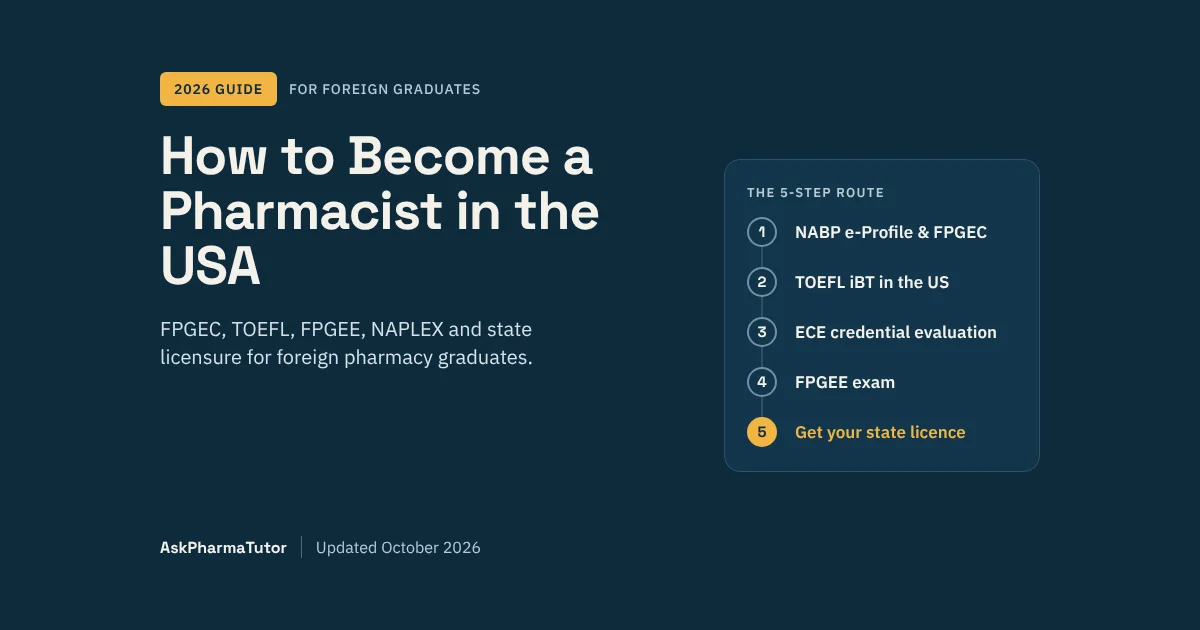
How to Become a Pharmacist in the USA (2026): FPGEC Guide
How to Become a Registered Pharmacist in the USA (2026 Guide for Foreign Graduates) Quick answer To practise as a pharmacist in the USA with a foreign degree, you need FPGEC certification from NABP, then a licence from a state board of pharmacy. Certification requires passing TOEFL iBT and the FPGEE, both taken in the US. Licensure usually adds internship hours, the NAPLEX and a state law exam. Allow 2–3 years or more. What changed in 2026 Two routes to a US pharmacist licence Most readers of this guide already hold a pharmacy degree from outside the US. For you, the route is FPGEC certification, covered in Steps 1–5 below. Route Who it is for Key steps FPGEC route Pharmacists with a degree from a pharmacy school outside the US NABP e-Profile → TOEFL/OET → ECE evaluation → FPGEE → state licence (internship, NAPLEX, MPJE) US Pharm-D route Students who earn a Pharm-D at an ACPE-accredited US school Pharm-D → NAPLEX → MPJE → state licence FPGEC certification is not a licence to practise. It only makes you eligible to apply for a licence in a US state. Step 1: Check eligibility and apply through your NABP e-Profile You are eligible for FPGEC certification if: How to apply: Time limit: you have 2 years from submitting the application to meet all acceptance requirements. Those requirements are Steps 2 and 3. Timing note: NABP is not accepting applications for the 2026 FPGEE. Applications reopen after the 15 October 2026 exam, for the 2027 sitting. Step 2: Pass the English language test (in the US) You must pass an English proficiency test before NABP will accept you to sit the FPGEE. You need only one test. Test What NABP requires TOEFL iBT Minimum score in each of Reading, Listening, Speaking and Writing. There is no overall-score requirement. Taken at a secure ETS test centre in an NABP member or associate member jurisdiction. Home Edition and international test sites are not accepted. Valid 2 years. OET for Pharmacy Accepted for tests taken on or after 11 January 2027. TOEFL scores after the 2026 scale change. ETS moved TOEFL iBT to a new score scale on 21 January 2026. NABP publishes its section minimums on the new scale in Step 3 of the FPGEC Bulletin. As a reference point, NABP’s earlier minimums of Reading 22, Listening 21, Speaking 26 and Writing 24 correspond to 4.5, 4.5, 5 and 5 on the new scale. Confirm the current table before you book. Common mistake: many older articles, including the 2019 version of this one, say you can take TOEFL anywhere in the world, or quote an overall score of 89. Neither is correct for FPGEC. Tips: Step 3: Get your credentials evaluated by ECE Educational Credential Evaluators (ECE) is the only organisation NABP accepts for evaluating foreign pharmacy credentials. Order a General Evaluation Report and have these sent to ECE: Licence verification. Your home licensing body, for example the Pharmacy Council of Pakistan or the relevant provincial council, must send proof of your licence or registration to NABP in a sealed envelope, with a seal, stamp or signature across the flap. NABP rejects envelopes that are tampered with or not properly sealed. Processing time. NABP’s evaluation takes about 12 weeks. It starts only once every document has arrived, including your passing English score report. Each resubmission after a deficiency notice adds another 12 weeks, so get the documents right the first time. Step 4: Pass the FPGEE The Foreign Pharmacy Graduate Equivalency Examination (FPGEE) checks that your education matches a US Pharm-D. You can register only after NABP accepts your FPGEC application. Feature Detail Format Computer-based, 200 questions Time 4.5 hours of testing within 5.5 hours of seat time Content Biomedical, pharmaceutical, social/behavioural/administrative and clinical sciences Passing score Scaled score of 75 When Once a year (2026 sitting: 15 October) Where Pearson test centres in the continental US only Attempts Maximum of 5 Results In your e-Profile about 8 weeks after the exam Key deadlines (2026 cycle): registration opens on 15 May, the deadline to buy the exam is 1 September, name changes close on 15 September, and scheduling or cancelling closes on 8 October. Expect similar dates each year. The 2-year acceptance window. Once accepted, you have 2 years to pass the FPGEE. NABP never extends this deadline. If it runs out, you must submit a new FPGEC application. Test day: your ID must exactly match the name on your e-Profile and your Authorization to Test (ATT), or you forfeit the fee. Check-in includes a photo, a signature and a palm vein scan. Once you pass the FPGEE and have a valid English score, you are FPGEC certified. There is no paper certificate. State boards check your status online. Step 5: Get licensed by a state board Each US state licenses its own pharmacists. Choose your target state early, because its rules decide what comes next. Most states require all three of the following. Internship hours Most boards require supervised practice hours for foreign graduates, completed as a registered intern after FPGEC certification. For example, Texas requires 1,500 board-approved internship hours. Texas waives this if you are already licensed in another US state. Requirements vary widely, so check your board’s foreign-graduate page. NAPLEX The North American Pharmacist Licensure Examination tests general practice knowledge. You can transfer your NAPLEX score to other states for $105 per state, but you must request this within 89 days of the exam. MPJE (law exam) The Multistate Pharmacy Jurisprudence Examination tests federal and state pharmacy law for the state you are applying to. A few states use their own law exam instead. Some boards also require a background check or an interview. Once you meet your board’s requirements, you receive your state pharmacist licence, and only then can you practise. Visas, costs and timeline Visas are the hidden step. TOEFL and the FPGEE must both be taken in the US, so most candidates living abroad need a US visa