
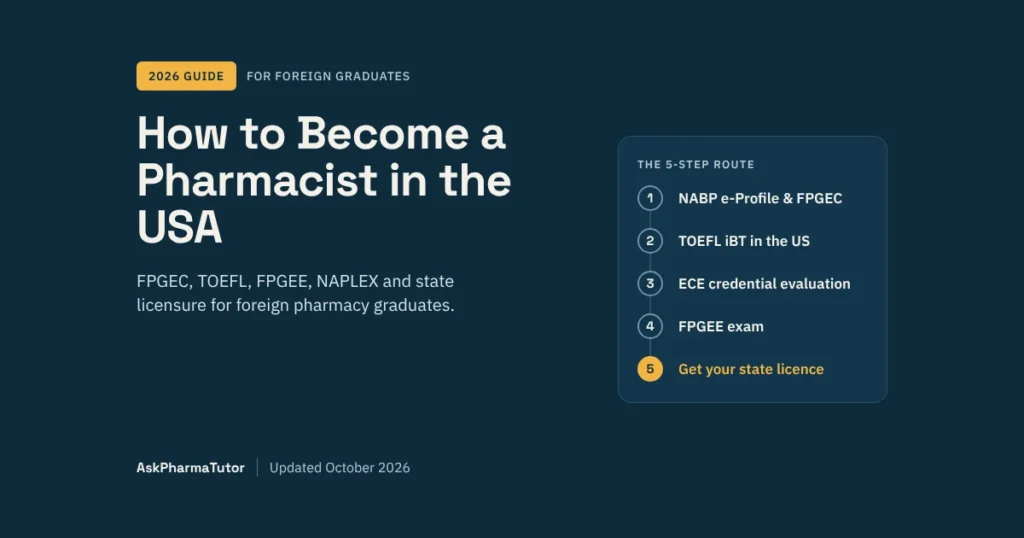
How to Become a Registered Pharmacist in the USA (2026 Guide for Foreign Graduates)
Quick answer
To practise as a pharmacist in the USA with a foreign degree, you need FPGEC certification from NABP, then a licence from a state board of pharmacy. Certification requires passing TOEFL iBT and the FPGEE, both taken in the US. Licensure usually adds internship hours, the NAPLEX and a state law exam. Allow 2–3 years or more.
- Create an NABP e-Profile and apply for FPGEC certification.
- Pass TOEFL iBT at a US test centre (OET for Pharmacy is accepted from January 2027).
- Have your credentials evaluated by ECE and send licence verification.
- Pass the FPGEE, held once a year in the US.
- Complete state requirements: internship hours, the NAPLEX and the MPJE.
What changed in 2026
- TOEFL score scale: ETS changed the TOEFL iBT scale on 21 January 2026, and NABP now publishes equivalent minimum section scores on the new scale.
- US test centres only: TOEFL must be taken at a secure ETS test centre in an NABP jurisdiction. International test sites and Home Edition are not accepted.
- OET accepted from 2027: OET for Pharmacy is accepted for tests taken on or after 11 January 2027.
- TOEFL MyBest Scores: accepted for applications submitted on or after 1 November 2026.
- FPGEE once a year: the 2026 exam is on 15 October. Applications for 2027 open after that date.
- No ID card: since 1 April 2026, NABP no longer issues the FPGEE Identification Card.
Two routes to a US pharmacist licence
Most readers of this guide already hold a pharmacy degree from outside the US. For you, the route is FPGEC certification, covered in Steps 1–5 below.
| Route | Who it is for | Key steps |
| FPGEC route | Pharmacists with a degree from a pharmacy school outside the US | NABP e-Profile → TOEFL/OET → ECE evaluation → FPGEE → state licence (internship, NAPLEX, MPJE) |
| US Pharm-D route | Students who earn a Pharm-D at an ACPE-accredited US school | Pharm-D → NAPLEX → MPJE → state licence |
FPGEC certification is not a licence to practise. It only makes you eligible to apply for a licence in a US state.
Step 1: Check eligibility and apply through your NABP e-Profile
You are eligible for FPGEC certification if:
- Degree length: your pharmacy degree is from a recognised school outside the US, and the programme was at least 5 years if you graduated on or after 1 January 2003 (at least 4 years for earlier graduates). A Pakistani Pharm-D meets this rule. Check the length of a B.Pharm carefully.
- Licence: you hold an unrestricted pharmacist licence or registration in your home country. If your country issues both, submit both.
How to apply:
- Create an NABP e-Profile and note your e-Profile ID.
- Read the current FPGEC Candidate Application Bulletin.
- Submit the FPGEC application through your e-Profile with the signed attestation and a photo ID. Do not send supporting documents until the application is submitted.
Time limit: you have 2 years from submitting the application to meet all acceptance requirements. Those requirements are Steps 2 and 3.
Timing note: NABP is not accepting applications for the 2026 FPGEE. Applications reopen after the 15 October 2026 exam, for the 2027 sitting.
Step 2: Pass the English language test (in the US)
You must pass an English proficiency test before NABP will accept you to sit the FPGEE. You need only one test.
| Test | What NABP requires |
| TOEFL iBT | Minimum score in each of Reading, Listening, Speaking and Writing. There is no overall-score requirement. Taken at a secure ETS test centre in an NABP member or associate member jurisdiction. Home Edition and international test sites are not accepted. Valid 2 years. |
| OET for Pharmacy | Accepted for tests taken on or after 11 January 2027. |
TOEFL scores after the 2026 scale change. ETS moved TOEFL iBT to a new score scale on 21 January 2026. NABP publishes its section minimums on the new scale in Step 3 of the FPGEC Bulletin. As a reference point, NABP’s earlier minimums of Reading 22, Listening 21, Speaking 26 and Writing 24 correspond to 4.5, 4.5, 5 and 5 on the new scale. Confirm the current table before you book.
Common mistake: many older articles, including the 2019 version of this one, say you can take TOEFL anywhere in the world, or quote an overall score of 89. Neither is correct for FPGEC.
Tips:
- Use the code NABPTOEFL for 15% off the TOEFL fee.
- From 1 November 2026, TOEFL MyBest Scores (best section scores across sittings) are accepted for new applications.
- Many pharmacists plan one US trip to sit TOEFL, and a second for the FPGEE (Step 4).
Step 3: Get your credentials evaluated by ECE
Educational Credential Evaluators (ECE) is the only organisation NABP accepts for evaluating foreign pharmacy credentials. Order a General Evaluation Report and have these sent to ECE:
- ☐ Official transcripts, sent directly by your university
- ☐ Proof of your pharmacy degree
- ☐ Certified English translations of any non-English documents
- ☐ ECE General Evaluation Report fee
Licence verification. Your home licensing body, for example the Pharmacy Council of Pakistan or the relevant provincial council, must send proof of your licence or registration to NABP in a sealed envelope, with a seal, stamp or signature across the flap. NABP rejects envelopes that are tampered with or not properly sealed.
Processing time. NABP’s evaluation takes about 12 weeks. It starts only once every document has arrived, including your passing English score report. Each resubmission after a deficiency notice adds another 12 weeks, so get the documents right the first time.
Step 4: Pass the FPGEE
The Foreign Pharmacy Graduate Equivalency Examination (FPGEE) checks that your education matches a US Pharm-D. You can register only after NABP accepts your FPGEC application.
| Feature | Detail |
| Format | Computer-based, 200 questions |
| Time | 4.5 hours of testing within 5.5 hours of seat time |
| Content | Biomedical, pharmaceutical, social/behavioural/administrative and clinical sciences |
| Passing score | Scaled score of 75 |
| When | Once a year (2026 sitting: 15 October) |
| Where | Pearson test centres in the continental US only |
| Attempts | Maximum of 5 |
| Results | In your e-Profile about 8 weeks after the exam |
Key deadlines (2026 cycle): registration opens on 15 May, the deadline to buy the exam is 1 September, name changes close on 15 September, and scheduling or cancelling closes on 8 October. Expect similar dates each year.
The 2-year acceptance window. Once accepted, you have 2 years to pass the FPGEE. NABP never extends this deadline. If it runs out, you must submit a new FPGEC application.
Test day: your ID must exactly match the name on your e-Profile and your Authorization to Test (ATT), or you forfeit the fee. Check-in includes a photo, a signature and a palm vein scan.
Once you pass the FPGEE and have a valid English score, you are FPGEC certified. There is no paper certificate. State boards check your status online.
Step 5: Get licensed by a state board
Each US state licenses its own pharmacists. Choose your target state early, because its rules decide what comes next. Most states require all three of the following.
Internship hours
Most boards require supervised practice hours for foreign graduates, completed as a registered intern after FPGEC certification. For example, Texas requires 1,500 board-approved internship hours. Texas waives this if you are already licensed in another US state. Requirements vary widely, so check your board’s foreign-graduate page.
NAPLEX
The North American Pharmacist Licensure Examination tests general practice knowledge.
- 225 questions (200 scored, 25 unscored pretest), in a 6-hour appointment at Pearson centres
- Results are pass/fail
- Typical fee: about $620 (application plus exam), plus any state fees
- Retakes: a 45-day wait after a failed attempt, and no more than 3 attempts in 12 months
You can transfer your NAPLEX score to other states for $105 per state, but you must request this within 89 days of the exam.
MPJE (law exam)
The Multistate Pharmacy Jurisprudence Examination tests federal and state pharmacy law for the state you are applying to. A few states use their own law exam instead. Some boards also require a background check or an interview.
Once you meet your board’s requirements, you receive your state pharmacist licence, and only then can you practise.
Visas, costs and timeline
Visas are the hidden step. TOEFL and the FPGEE must both be taken in the US, so most candidates living abroad need a US visa just to sit the exams, usually a visitor visa. Working as an intern, and later as a pharmacist, needs a visa that permits employment. NABP and state boards do not handle immigration. Check travel.state.gov and uscis.gov, or speak to a qualified immigration attorney, before you pay any fees.
| Item | Approximate cost | Paid to |
| FPGEC application | Per current FPGEC Bulletin | NABP |
| TOEFL iBT | ETS fee (15% off with code NABPTOEFL) | ETS |
| ECE General Evaluation Report | Per ECE fee schedule | ECE |
| FPGEE (and any retake) | Per current FPGEC Bulletin | NABP |
| NAPLEX | ~$620 | NABP |
| MPJE and state licence | Varies by state | NABP / state board |
| US travel and visas for TOEFL and the FPGEE | Varies | US embassy, airlines |
Timeline: expect 2–3+ years from your first application to holding a licence. The FPGEE is offered only once a year, NABP review takes about 12 weeks, and internship hours can take 6–12 months on top.
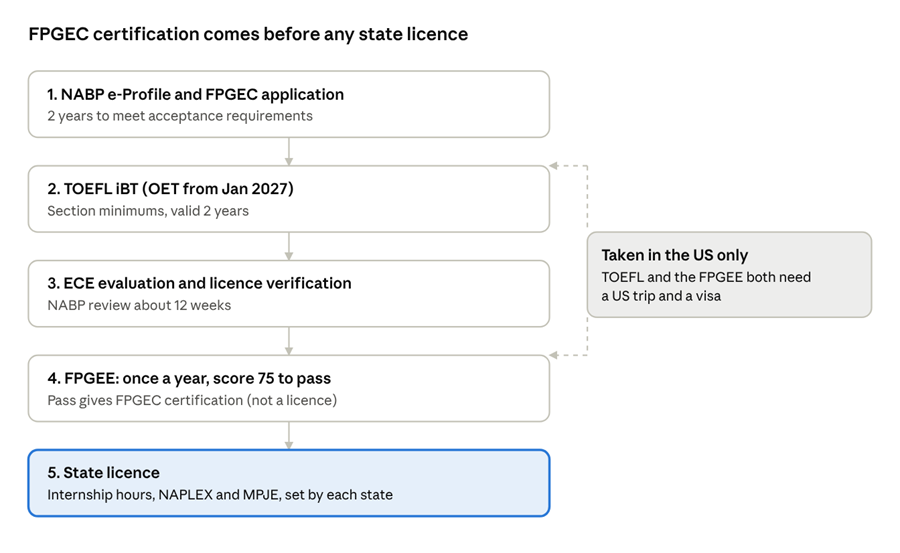
FPGEC route to a US pharmacist licence · 5 stages
Steps 2 and 4 both require a trip to the US, so plan visas before you pay any fees.
The US Pharm-D route in brief
If you have not yet qualified, or prefer to retrain, you can earn a Pharm-D at an ACPE-accredited US school. This bypasses FPGEC entirely.
- Programme length: usually 2+ years of pre-pharmacy coursework followed by a 4-year Pharm-D. Some schools offer 0–6 (direct-entry) or accelerated 3-year programmes.
- How to apply: apply through PharmCAS. The PCAT has been retired, so admissions no longer use it.
- Licensure: after graduation, pass the NAPLEX and the MPJE and meet your state’s internship rules, which are usually built into the Pharm-D.
- Cost: this is a far more expensive route for international students and needs an F-1 student visa. It does, however, give you a US degree.
Frequently asked questions
Can I take TOEFL or the FPGEE in Pakistan, India or the Middle East?
No. NABP accepts TOEFL iBT only from secure ETS test centres in NABP jurisdictions, and the FPGEE is offered only at Pearson centres in the continental US.
What TOEFL score do I need for FPGEC?
NABP sets a minimum for each of the four sections, with no overall requirement. Since the January 2026 scale change, the minimums are published on the new ETS scale in the FPGEC Bulletin.
Is a Pakistani Pharm-D accepted?
Yes. It is a 5-year programme, which meets NABP’s rule for degrees awarded from 2003 onwards. You will also need an unrestricted licence from your home country.
How many times is the FPGEE held each year?
Once. The 2026 sitting is on 15 October.
How long is my FPGEC acceptance valid?
You have 2 years from acceptance to pass the FPGEE, and NABP never extends this deadline.
Does FPGEC certification let me work as a pharmacist?
No. It makes you eligible to apply for a state licence. You still need internship hours, the NAPLEX and the MPJE.
Which state is easiest for foreign graduates?
There is no single answer. Compare internship-hour requirements, NAPLEX score transfer rules, and whether a state counts hours earned elsewhere.
Is the UK route faster?
The UK route takes about 2–2.5 years. See our UK pharmacist registration guide.
Official sources
NABP and state boards update their rules often. This guide was checked against these sources in October 2026, so always confirm the current position before you pay.
- NABP – Foreign Pharmacy Graduate (FPGEC) program
- NABP – FPGEE
- NABP FPGEC Bulletin – TOEFL iBT score requirements
- NABP – NAPLEX
- Educational Credential Evaluators (ECE)
- Texas State Board of Pharmacy – Foreign graduate requirements
- US Bureau of Labor Statistics – Pharmacists (median pay $140,910, May 2025)
- PharmCAS
Disclaimer: this guide is for general information and is not legal or immigration advice.
