
Last reviewed: November 2026 by Dr. Farrukh Mehmood, Ph.D., 16+ years in pharmaceutical QC/QA
Key takeaways
- Pharmacists in Qatar are licensed by the Department of Healthcare Professions (DHP) at the Ministry of Public Health, formerly the Qatar Council for Healthcare Practitioners (QCHP).
- For the Pharmacist scope you need a pharmacy degree and two years of post-graduate experience covered by a registration licence.
- The qualifying exam is the National Pharmacist Qualifying Examination: 150 questions, pass mark 60%, delivered by Prometric. DHP currently allows unlimited attempts.
- DHP’s guideline does not ask for an employer at the evaluation stage, but you must upload your exam pass and verification report with the application. A preliminary evaluation is valid for 6 months.
- Applicants with a master’s degree in a pharmacy-related field are exempt from the exam, and Industrial Pharmacists sit a GMP exam instead of the Prometric exam.
DHP publishes detailed guidelines for pharmacists, an exam blueprint and an official reference list, so you can plan the whole route before you spend money. This guide summarises the route as DHP’s own documents describe it in 2026, including the scope of practice that fits your degree, the order of steps, the exam, and what is needed for the final licence. It also covers the Industrial Pharmacist scope, which matters if you work in manufacturing, QC or QA.
Which scope of practice fits you?
DHP licenses pharmacists under different scopes, each with its own requirements. From DHP’s Guidelines for Pharmacists:
| Scope | Academic requirement | Experience | Qualifying exam |
|---|---|---|---|
| Pharmacist | Bachelor’s degree in pharmacy | 2 years post-graduate | Prometric required |
| Pharmacist | Bachelor’s in pharmacy + master’s in a pharmacy-related field (or equivalent) | 2 years post-graduate | Exempt |
| Clinical Pharmacist | Bachelor’s in pharmacy + Pharm-D (including rotations) | 2 years post-graduate | Prometric required |
| Clinical Pharmacist | Bachelor’s in pharmacy + master’s in clinical pharmacy | 2 years post-graduate | Exempt |
| Industrial Pharmacist | Bachelor’s degree in pharmacy | 2 years post-graduate | GMP exam (Pharmacy and Drug Control Department) |
Every scope also needs a registration licence from the country where you gained your experience. DHP decides which scope your degree fits, so confirm it before you book an exam. If you also hold an M.Phil or another master’s in a pharmacy-related subject, ask DHP whether it counts as the master’s that gives an exam exemption.
Experience must be licensed. DHP does not count work experience that is not covered by a registration licence. List every pharmacy job, with dates, from the start.
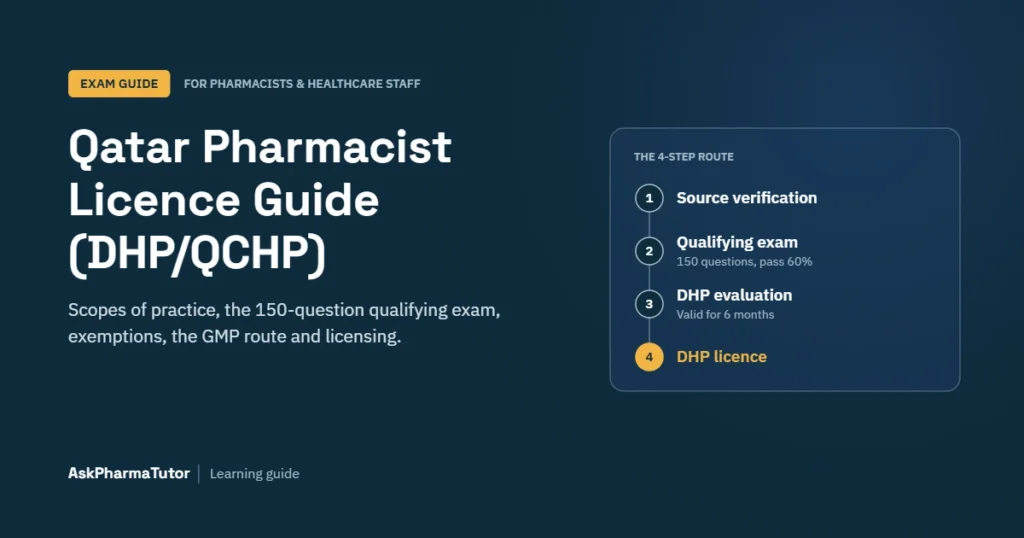
Step by step: how to get a DHP licence
1. Start verification and pass the exam
DHP’s evaluation request asks for a copy of your primary source verification report and your qualifying exam pass certificate, so complete both before you apply. Verification by DHP’s approved companies replaces attestation, so you do not need to attest your certificates.
2. Apply for evaluation online
Submit an evaluation request through DHP’s Registration and Licensing System. DHP’s guideline does not ask for an employer at this stage. Upload your passport, a recent photo, a CV on DHP’s template, degrees and transcripts, experience certificates (dated, signed and stamped), the licences covering your experience, the verification report and your exam certificate. DHP aims to review a complete application in 15 working days.
3. Receive your preliminary evaluation
If you meet the requirements, DHP issues a preliminary evaluation. It is valid for 6 months: if you do not apply for a temporary or permanent licence within that time, you must apply for evaluation again.
4. Apply for the licence with your employer
Once you have a job, you apply for licensing with your Qatar ID (QID; if you are on employer sponsorship, the sponsor must be your employer), a police clearance certificate, a medical report, a recognised CPR course and a Certificate of Good Standing sent directly by your registration authority (or verified by the verification company). A non-renewable 6-month temporary licence is also available while you complete the requirements.
The National Pharmacist Qualifying Examination
| Item | Detail |
|---|---|
| Format | Computer-based multiple-choice exam, delivered by Prometric |
| Questions | 150 |
| Time | 3 hours on DHP’s exam page (the blueprint document lists 3½ hours); check your booking |
| Pass mark | 60%, with no rounding of scores |
| Attempts | Unlimited, according to DHP’s qualifying examination page |
| Content updated | New content and references from 1 May 2025 |
What the exam covers
| Area | Questions | Share |
|---|---|---|
| Basic Biomedical Sciences | 7 | About 5% |
| Pharmaceutical Sciences | 38 | About 25% |
| Social, Behavioural and Administrative Sciences | 38 | About 25% |
| Clinical Sciences | 67 | About 45% |
| Total | 150 | 100% |
Clinical sciences make up almost half the paper, and social and administrative pharmacy a quarter. DHP’s primary references are Comprehensive Pharmacy Review for NAPLEX (8th edition) and The APhA Complete Review for Pharmacy (12th edition), plus Ministry of Public Health documents such as the Qatar National Health Strategy 2024–2030, Qatar National Health Services and the Qatar Dietary Guidelines. Secondary references include clinical pharmacokinetics texts, Patient Assessment in Pharmacy Practice, Ansel’s dosage forms, a medical ethics manual, the JCI hospital standards and pharmacy management texts.
Exemptions
Besides the master’s-degree exemptions in the scope table, DHP publishes a list of international exams that exempt their holders from the qualifying exam in Circular DHP/2025/19, linked from its Qualifying Examination page. Read the current list there before you book, and remember that an exemption covers only the exam: verification, experience and the other requirements still apply.
Industrial Pharmacist: an option for QC and QA professionals
If your experience is in pharmaceutical manufacturing, quality control or quality assurance, the Industrial Pharmacist scope may suit you better than community or hospital practice. It needs a bachelor’s degree in pharmacy and two years of post-graduate experience, and instead of the Prometric exam you sit a GMP exam conducted by the Pharmacy and Drug Control Department. Changing later from Industrial Pharmacist to Pharmacist requires a valid Prometric pass, and the reverse requires the GMP exam.
For GMP revision, our guides on OOS investigations, CAPA, method validation and stability studies cover the core topics, and the GMP and QA Quiz lets you test yourself.
How to prepare for the Pharmacist exam: a 10-week plan
| Weeks | Focus |
|---|---|
| 1 | Read the blueprint and take a timed 50-question practice set. |
| 2–5 | Clinical sciences (45%): therapeutics by organ system, patient assessment, lab values, pharmacokinetics and counselling. |
| 6–7 | Pharmaceutical sciences (25%): pharmacology, dosage forms, compounding and calculations. |
| 8 | Social and administrative sciences (25%): ethics, communication, management, and the Qatar health strategy and services documents. |
| 9 | Basic biomedical review and two full timed mocks. |
| 10 | Revise mistakes only, then sit the exam. |
For quick timed practice, use our free Pharmacology Quiz and Pharmaceutical Calculations Quiz.
Checklist for Pakistani pharmacists
- Pharm-D degree certificate and full transcripts (and any master’s degree)
- Pharmacy Council registration licences covering your two years of experience
- Experience certificates with issue date, signature and stamp
- CV on DHP’s template, listing every pharmacy job
- Passport and a recent photo meeting DHP’s criteria
- Certificate of Good Standing, sent directly by your council at the licensing stage
Frequently asked questions
Is QCHP the same as DHP?
Yes. The Qatar Council for Healthcare Practitioners (QCHP) is now the Department of Healthcare Professions (DHP) at the Ministry of Public Health. Many people still say “QCHP exam”.
How many times can I take the Qatar pharmacist exam?
DHP’s qualifying examination page currently says applicants may attempt the exam an unlimited number of times. Check the page before you book, because policies change.
Do I need a job offer to apply?
Not for evaluation: DHP’s guideline does not ask for an employer at that stage. For the licensing stage you need a job and a Qatar ID; if you are on employer sponsorship, your employer must be the sponsor.
Do I need to attest my certificates?
No. DHP states that verification by its approved verification companies replaces attestation by the competent authorities.
Where can I take the exam?
It is delivered by Prometric. DHP lists a test centre in Doha, and you book through Prometric’s online booking page for the DHP exams.
Related guides
- Working abroad as a pharmacist: every licensing route compared
- Saudi SPLE pharmacist licence guide
- DHA and MOHAP pharmacist licence guide (UAE)
References
- Ministry of Public Health, Qatar, Department of Healthcare Professions. Guidelines for Pharmacists.
- Department of Healthcare Professions. Qualifying Examination page.
- Department of Healthcare Professions. National Pharmacist Qualifying Examination Blueprint and References.
- Department of Healthcare Professions. Circular DHP/2025/19: qualifying exams that exempt from Qatar’s qualifying exam.
- Prometric. Department of Healthcare Professions (DHP–MOPH) test-taker information.
This guide is for information. Requirements are set by DHP and change through circulars; always confirm the current rules on the DHP website before you apply.
