
Last reviewed: November 2026 by Dr. Farrukh Mehmood, Ph.D., 16+ years in pharmaceutical QC/QA
Key takeaways
- Pharmacists in Saudi Arabia are licensed by the Saudi Commission for Health Specialties (SCFHS). You apply, pay and track everything on its online platform, Mumaris+.
- Your degree, licence and experience are checked at the source by DataFlow (primary source verification). Start it early: it is usually the slowest step.
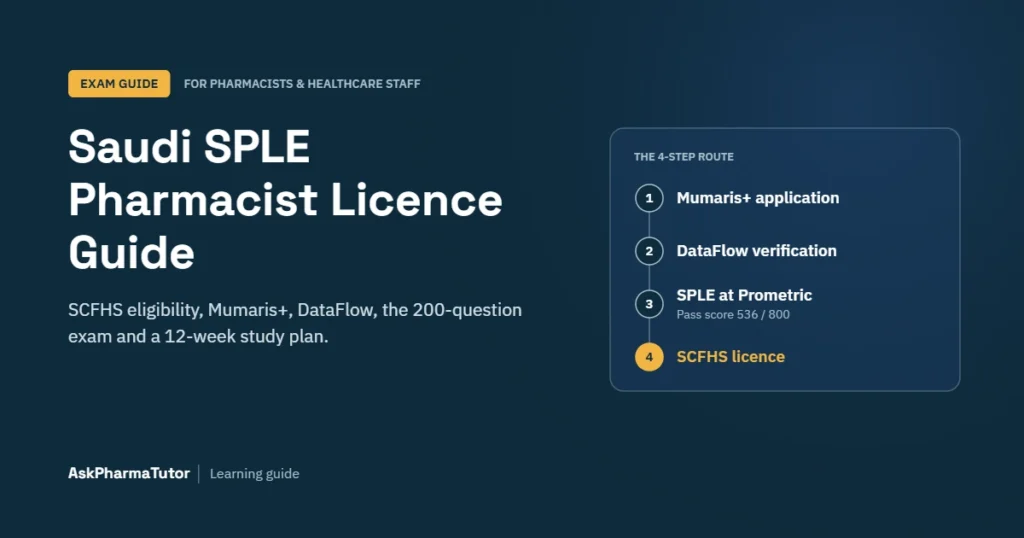
- The Saudi Pharmacist Licensure Examination (SPLE) has 200 questions in two parts of 120 minutes, with a 30-minute break. The pass score is 536 on a 200–800 scale.
- You can sit the SPLE up to four times a year at SCFHS-approved Prometric centres, in Saudi Arabia and abroad. Results come 2–6 weeks after the testing window closes.
- For Pakistani pharmacists, the five-year Pharm-D fits SCFHS’s rule that a pharmacy degree must involve five years of study. Keep your name identical on every document.
Every pharmacist who wants to work in Saudi Arabia, in a hospital, a community pharmacy or industry, needs a licence from SCFHS. This guide explains the route as it works in 2026: who regulates you, who is eligible, how Mumaris+ and DataFlow fit together, what the SPLE looks like, and how to prepare. The exam facts come from the official SPLE Applicant Guide published by SCFHS. It is written for pharmacists in Pakistan and similar countries, but the steps are the same for everyone with a foreign degree.
Who licenses pharmacists in Saudi Arabia?
Two bodies are easy to confuse:
- SCFHS (Saudi Commission for Health Specialties) licenses people: it classifies and registers every healthcare practitioner, including pharmacists, and runs the SPLE.
- SFDA (Saudi Food and Drug Authority) regulates products: drug registration, manufacturing, pharmacovigilance. If you want an industry or regulatory job, you will deal with SFDA rules, but your professional licence still comes from SCFHS.
Mumaris+ is not a separate authority. It is simply SCFHS’s online portal, where you create your account, submit your classification application, pay fees and receive decisions.
Are you eligible?
SCFHS decides your eligibility and your professional title (for example Pharmacist, or a higher grade for specialists) when it reviews your application. In general you need:
- A recognised pharmacy degree. SCFHS’s classification manual requires a pharmacy degree with a study period of five years. Pakistan’s Pharm-D is a five-year programme, so it meets that rule. If you hold an older four-year B.Pharm, check how SCFHS will treat it before you pay any fees.
- Registration in your home country. SCFHS asks for a copy of your licence or professional registration from the recognised authority in your country. For Pakistan this is the Pharmacy Council of Pakistan (or your provincial pharmacy council).
- Internship and experience records. The Mumaris+ requirements list a copy of your qualification, your internship certificate and your home licence. Many Saudi employers also ask for one to two years of post-registration experience, so collect experience letters on company letterhead now.
Before you pay anything: SCFHS updates its requirements and fees without much notice. Read the current requirements inside Mumaris+ for the exact title you are applying for.
Step by step: how to get an SCFHS pharmacist licence
1. Prepare your documents
Gather clear scans of your degree, transcripts, internship certificate, home registration certificate, a recent Good Standing Certificate, experience letters and passport. The single most common reason for delays is a name that is spelled differently on different documents, so fix any mismatch with the issuing body before you start.
2. Create your Mumaris+ account and apply for classification
Register on Mumaris+, choose the professional classification service, select the correct profession and title, upload your documents and pay the fee. Choosing the wrong title is one of the most common reasons applications are sent back.
3. Complete DataFlow verification
DataFlow contacts your university, pharmacy council and employers directly to confirm your documents are genuine. Pakistani institutions can be slow to reply, so tell your university registrar and previous employers to expect a DataFlow request and answer it quickly.
4. Receive your scheduling permit
When SCFHS processes your exam application, it issues a scheduling permit with an eligibility period and emails you instructions for accessing it. You need this permit to book the exam.
5. Book and sit the SPLE
You book through Prometric. Scheduling may not be open more than three months in advance, and you can test at any SCFHS-approved Prometric centre in Saudi Arabia or abroad; the available locations appear when you schedule.
6. Professional registration
After you pass and your classification is approved, professional registration completes your licence. It is usually done once you have a Saudi employer, and SCFHS registration lasts two years before renewal.
The SPLE exam at a glance
| Item | Detail |
|---|---|
| Format | Computer-based, multiple choice, four options per question |
| Questions | 200, in two parts of 100 (up to 10% are unscored pilot questions) |
| Time | 120 minutes per part, with a scheduled 30-minute break |
| Pass score | 536 on a reporting scale of 200–800 |
| Results | Not instant: announced 2–6 weeks after the testing window closes, with a feedback report |
| Attempts | Up to four per year from your first attempt; after passing, two more attempts are allowed to improve your score |
| Where | SCFHS-approved Prometric centres in Saudi Arabia and abroad |
| Fee | Shown when you book; it varies by country |
What the SPLE covers
| Section | Weight | Main topics |
|---|---|---|
| Basic Biomedical Sciences | 10% | Physiology, biochemistry, microbiology, immunology |
| Pharmaceutical Sciences | 35% | Medicinal chemistry, pharmacology and toxicology, pharmacognosy, pharmaceutics, pharmacokinetics, sterile and non-sterile compounding, calculations |
| Social, Behavioural and Administrative Sciences | 20% | Saudi healthcare system, pharmacoepidemiology, pharmacoeconomics, practice management, law, biostatistics, ethics, communication |
| Clinical Sciences | 35% | Drug information, clinical pharmacokinetics, patient assessment, therapeutics, counselling, special populations |
The blueprint can vary by up to 5% in each area. Two things surprise many candidates: about a fifth of the paper is social and administrative pharmacy, including Saudi law and the Saudi healthcare system, and clinical questions use scenarios rather than simple recall.
Exam-day rules that cost people an attempt
- Arriving more than 30 minutes late, or not turning up, counts as an attempt unless the committee accepts a documented reason.
- Bring your scheduling permit (paper or on your phone) and an unexpired passport. Your name must match the permit exactly.
- You cannot sit the SPLE twice in the same testing window: the second sitting is counted as an attempt and its result is invalid.
- Break time is fixed. If you overrun, the next part starts automatically and the extra time comes out of your exam time.
How to prepare: a 12-week plan
| Weeks | Focus |
|---|---|
| 1–2 | Read the official blueprint. Take the SCFHS practice exam to find your weak areas. |
| 3–5 | Pharmaceutical sciences: pharmacology, medicinal chemistry, pharmaceutics, pharmacokinetics and calculations (35%). |
| 6–8 | Clinical sciences: therapeutics by organ system, TDM drugs, lab values, counselling, special populations (35%). |
| 9–10 | Social and administrative sciences: Saudi healthcare system, pharmacy law, ethics, biostatistics, pharmacoeconomics (20%). |
| 11 | Basic biomedical sciences review (10%) and mixed timed practice. |
| 12 | Two full timed mocks of 200 questions with the 30-minute break, then revise errors only. |
SCFHS lists study references including The APhA Complete Review for Pharmacy, Comprehensive Pharmacy Review, Lippincott’s illustrated reviews of pharmacology and biochemistry, Dipiro’s Pharmacotherapy, Ansel’s Pharmaceutical Calculations and Lexicomp, plus the SFDA drug list and Saudi controlled-drug rules. SCFHS notes that the list is a study aid and that questions are not necessarily taken from these books.
For quick timed practice, try our free Pharmacology Quiz, Pharmaceutical Calculations Quiz and Medicinal Chemistry Quiz, each with an explanation for every answer.
Checklist for Pakistani pharmacists
- Pharm-D degree and full transcripts from your university
- Pharmacy Council registration certificate and a recent Good Standing Certificate
- Internship or house-job certificate, if you completed one
- Experience letters on letterhead with your title, dates and duties
- Passport, with your name spelled exactly as on your degree
- HEC-attested copies of your degree: not part of the SCFHS application itself, but often asked for later at the visa stage, so ask your employer which attestations they need
Frequently asked questions
Is the SPLE required for every foreign pharmacist?
Yes for most. SCFHS describes the SPLE as the licensure exam pharmacists must pass, and it is also used for entry to SCFHS postgraduate training. SCFHS decides any exemption when it classifies you, so do not assume one.
What is the SPLE pass mark?
536 on a scale of 200–800, set through a standard-setting exercise with a panel of Saudi pharmacists and approved by the SCFHS Central Assessment Committee.
How many times can I take the SPLE?
Up to four times a year, counted from your first attempt. Only one sitting per testing window counts. After you pass, you may take two further attempts to improve your score, which mainly matters for residency selection.
Can I take the SPLE in Pakistan?
SCFHS allows testing at any approved Prometric centre locally and internationally. Check the centres offered when you schedule, because the list can change.
Do I need a job offer before I start?
No. You can complete classification, DataFlow and the SPLE first, which makes you far more attractive to employers. Final professional registration is usually completed once you have a Saudi employer.
Related guides
- Working abroad as a pharmacist: every licensing route compared
- DOH (HAAD) exam for pharmacists: Abu Dhabi licence guide
- How to become a pharmacist in the UK: OSPAP and GPhC
- How to become a pharmacist in the USA: FPGEC guide
References
- Saudi Commission for Health Specialties. Saudi Pharmacist Licensure Examination (SPLE): Examination Content Guideline / Applicant Guide (September 2025).
- Saudi Commission for Health Specialties. Mumaris+ frequently asked questions: professional classification and registration requirements.
- Saudi Commission for Health Specialties. Professional Classification and Registration Manual.
- Prometric. Saudi Commission for Health Specialties test-taker information.
This guide is for information. Requirements, fees and procedures are set by SCFHS and can change; always confirm the current rules on the SCFHS website and inside Mumaris+ before you apply.
