
Last reviewed: October 2026 by Dr. Farrukh Mehmood, Ph.D., 16+ years in pharmaceutical QC/QA
Key takeaways
- HAAD is now the Department of Health – Abu Dhabi (DOH). Many people still say “HAAD exam”, but licences are issued by DOH and applications are made through TAMM, Abu Dhabi’s government services platform.
- To be eligible for the Pharmacist title you need a BSc in Pharmacy or PharmD plus two years of post-qualification experience in a related field. Experience in pharmaceutical companies or sales does not count.
- DOH has your documents verified at the source by DataFlow (primary source verification). Your Good Standing Certificate must be no more than 6 months old.
- The licensing exam is computer-based. You book it through TAMM, and Pearson VUE delivers it. You get three attempts across all UAE health authorities.
- Pharmacists licensed in recognised countries, such as the UK, USA, Canada, Australia and Ireland, may be exempt from the exam.
To work as a pharmacist in Abu Dhabi you need a professional licence from the Department of Health – Abu Dhabi (DOH), the authority that used to be called HAAD. This guide covers the full route for pharmacists and clinical pharmacists as it works today. It explains who is eligible under the UAE’s unified qualification requirements (PQR), how DataFlow verification and the TAMM application work, what to expect in the Pearson VUE exam, who is exempt, and how to prepare. All the eligibility rules come from the official Unified Healthcare Professional Qualification Requirements (April 2025 edition).
HAAD or DOH: what changed?
The Health Authority – Abu Dhabi (HAAD) was restructured as the Department of Health – Abu Dhabi (DOH), and DOH now regulates healthcare professionals in the emirate. “HAAD exam” and “HAAD licence” are still the names most people search for, but every step now runs under DOH:
- You apply and pay through TAMM, not the old haad.ae e-licensing system.
- You book your exam through TAMM, and Pearson VUE delivers it.
- DOH uses the same Unified Healthcare Professional Qualification Requirements (PQR) as the Ministry of Health and Prevention (MOHAP), the Dubai Health Authority (DHA) and the Sharjah Health Authority. Eligibility rules are therefore the same across the UAE, even though each authority runs its own application process.
Which UAE authority do you need?
| Where you will work | Licensing authority |
|---|---|
| Abu Dhabi emirate (including Al Ain and Al Dhafra) | Department of Health – Abu Dhabi (DOH) |
| Dubai | Dubai Health Authority (DHA) |
| Sharjah | Sharjah Health Authority (SHA), for facilities under its jurisdiction |
| Other northern emirates and federal facilities | Ministry of Health and Prevention (MOHAP) |
If you already hold a valid licence from one UAE authority, the PQR allows the other authorities to recognise it without a new exam, for the same title. You still need a valid Good Standing Certificate and a full primary source verification report. An expired licence must not be more than six months past its expiry date.
Eligibility for pharmacists (PQR 2025)
The PQR sets the minimum qualification and experience for each pharmacy title:
| Title | Qualification | Experience required |
|---|---|---|
| Pharmacist | BSc in Pharmacy, or Doctor of Pharmacy (PharmD) | 2 years post-qualification, in a related field |
| Clinical Pharmacist | BSc in Pharmacy and a clinical pharmacy residency of at least 2 years | None* |
| PharmD of at least 6 years’ duration | 2 years post-qualification in a related field, including at least 6 months in a hospital setting | |
| BSc in Pharmacy and a 2-year postgraduate qualification leading to a PharmD or a master’s in clinical pharmacy | ||
| Bachelor’s or 4-year master’s in pharmacy and a UK postgraduate diploma in clinical pharmacy (at least 1 year) | ||
| Specialized Pharmacist (e.g. oncology, critical care, infectious diseases) | BSc/PharmD and a 1-year postgraduate qualification in the specialty | 2 years post-qualification in a related field |
| BSc/PharmD and American board certification in the specialty | None* | |
| Pharmacy Technician | Diploma in pharmacy (at least 2 years) | 2 years post-qualification in a related field |
*Subject to the gap of practice rules below.
Points that often trip up applicants:
- Only hands-on, licensed practice counts. Experience must be gained as a licensed professional in salaried or contracted employment. Teaching, non-clinical roles and experience with pharmaceutical companies or as a sales representative are not accepted.
- Your home licence must cover your experience. You need a valid licence or registration in your home country or last country of work, valid for the period of experience you are claiming.
- Good Standing Certificate (GSC): it must be issued by the regulator in your last country of employment and be no more than 6 months old when you apply.
- Accredited, in-person degrees only. Degrees gained by distance learning, by correspondence or on an honorary basis do not count.
Gap of practice
If you have been out of clinical practice for more than three years, you must complete CME/CPD credits and supervised training before you sit the exam:
| Gap of practice | Pharmacists must complete |
|---|---|
| 3 to less than 4 years | 20 CME/CPD credits + 6 months of training |
| 4 to less than 5 years | 30 CME/CPD credits + 8 months of training |
| More than 5 years | Not eligible for non-UAE nationals |
Step by step: how to get a DOH pharmacist licence
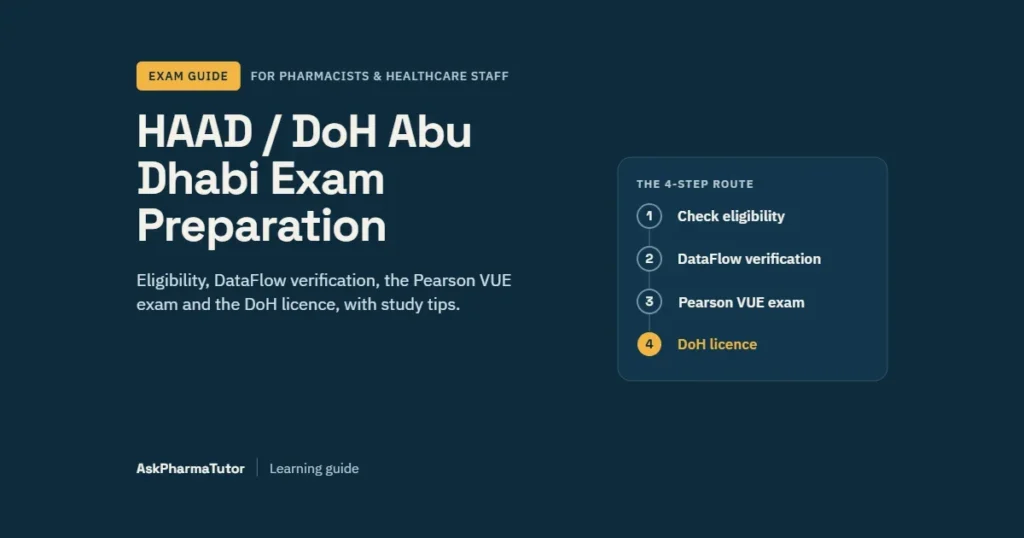
- Check your eligibility against the PQR table above for the title you want, and collect your documents: degree and transcript, home licence, experience certificates, Good Standing Certificate, passport and photo.
- Create an account on TAMM and start the healthcare professional licensing application with DOH.
- Complete DataFlow primary source verification (PSV). DataFlow contacts your university, licensing body and employers directly to confirm your documents. This is usually the slowest step, so start it early and reply quickly to any DataFlow queries.
- DOH reviews your application. Once the Health Professionals Licensing department approves it, you can pay the exam pre-booking fee in TAMM.
- Book the exam. After payment, a Pearson VUE booking link appears in your TAMM account, where you choose the date, time and test centre. Print your booking confirmation and take it with you.
- Pass the exam, unless you qualify for an exemption (see below).
- Get your licence and activate it. The licence becomes active when a DOH-licensed facility employs you and completes activation.
In practice, most applicants take a few months from application to licence. The main variables are how quickly your university and past employers respond to DataFlow, and how soon you can get an exam slot.
The DOH pharmacist exam
- Format: a computer-based multiple-choice exam in English at a Pearson VUE test centre. Your booking shows the number of questions and the time allowed for your title.
- Result: reported as pass or fail.
- Attempts: you have three attempts across all UAE authorities combined, not three per authority, and you must declare previous attempts. After three failures, the PQR allows one final attempt in limited cases. It also allows three new attempts if you gain an additional recognised qualification or at least two more years of clinical experience.
- Exemption for UAE nationals: UAE nationals and children of Emirati women are exempt from the authority exams.
What the exam covers
The exam tests whether you can practise safely as a pharmacist in the UAE. Expect questions across these competency areas:
| Area | What to revise |
|---|---|
| Pharmacology and therapeutics | Drug classes, mechanisms, doses and first-line treatment for common conditions: hypertension, diabetes, asthma and COPD, infections, pain, GI and mental health |
| Medication safety | Drug interactions, adverse drug reactions, contraindications, high-alert and look-alike sound-alike medicines, pregnancy and lactation |
| Dispensing and counselling | Prescription checking, patient counselling points, OTC and minor-ailment triage, and when to refer |
| Pharmaceutical calculations | Doses by weight and body surface area, dilutions, concentrations (% w/v, mg/mL, ppm), infusion rates |
| Pharmaceutics | Dosage forms, storage and stability, compounding basics |
| Professional practice | Ethics, confidentiality, controlled and narcotic medicines handling, quality and CPD |
Who is exempt from the exam?
Under the PQR’s exam equivalency criteria for pharmacists and clinical pharmacists, you can be exempt from the licensing exam in either of two cases.
1. You hold a valid licence and GSC from a listed country or regulator, and you obtained your qualification within the last three years or have no gap in practice since your last day of employment. The listed countries and regulators are:
- UK: General Pharmaceutical Council (GPhC)
- USA: any board under the National Association of Boards of Pharmacy (NABP)
- Canada: any NAPRA member
- Australia: Pharmacy Board of Australia
- New Zealand: Pharmacy Council of New Zealand
- Ireland: Pharmaceutical Society of Ireland
- Elsewhere: Austria, Belgium, Denmark, Finland, France, Germany, Iceland, Luxembourg, Netherlands, Norway, Singapore, South Africa, Sweden and Switzerland
2. You have passed the Emirates Pharmacy Residency Entry Examination (EPREE).
If your degree was not taught in English, or your licence is from a non-English-speaking country on the list, you must also show English proficiency. Accepted evidence is TOEFL 500 or above (or equivalent), IELTS 5.0 or above, OET grade C or above, or a Cambridge English score of 169 or above. An exemption only removes the exam. You must still meet the experience, verification and other licensing requirements.
How much does it cost?
DOH does not publish one fee table for the whole process. TAMM shows each fee when you reach that step. Plan for:
- DataFlow primary source verification, which is priced by the number and type of documents
- the DOH application and processing fees
- the exam pre-booking fee paid to DOH, plus the Pearson VUE exam fee
- the licence issue fee, and later the renewal fees
Check the amounts in TAMM and on DataFlow before you pay, because they change.
How to prepare: an 8-week plan
| Weeks | Focus |
|---|---|
| 1–2 | Cardiovascular, diabetes and endocrine, respiratory. Make one-page summaries of first-line drugs, doses and monitoring. |
| 3–4 | Infections and antibiotics, GI, pain, CNS and mental health. Learn the key drug interactions and adverse effects for each class. |
| 5 | Pharmaceutical calculations every day, plus pharmaceutics, storage and compounding. |
| 6 | Medication safety, special populations (pregnancy, paediatrics, elderly, renal and hepatic impairment) and OTC counselling. |
| 7 | Timed mixed MCQ sets. Review every wrong answer and note why you got it wrong. |
| 8 | Two full-length timed mocks, then light revision of your summaries and weak areas. |
Practise with our free quizzes and guides:
- Pharmacology quiz (20 MCQs with explanations)
- Pharmaceutical calculations quiz
- Medicinal chemistry quiz
- 11 drug interactions every pharmacist should know
- 12 drugs every emergency pharmacist should know
- LASA drugs: list and safe handling
- Adverse drug reactions guide
Exam day
- Bring your printed booking confirmation and the original, valid ID you used to register, normally your passport.
- Arrive early. Check-in includes an ID check, a photo and a signature.
- Phones, bags, watches, notes, food and drinks are not allowed in the testing room. They go in a locker.
- Read every question to the end. Many questions ask for the most appropriate or first-line option.
Recommended books
No book is written specifically for the DOH exam. These NAPLEX review books cover the same therapeutics, calculations and drug information, and are widely used for Gulf licensing exams. Buy the latest edition.
- RxPrep Course Book: very comprehensive and organised by disease state, which makes it good for systematic revision.
- Comprehensive Pharmacy Review for NAPLEX: a detailed chapter-by-chapter review, from disease states to special populations.
- APhA Complete Review for Pharmacy: a solid all-round review including drug information and calculations.
These are affiliate links. AskPharmaTutor may earn a small commission at no extra cost to you.
After you are licensed: renewal and CPD
Pharmacists must complete at least 20 CME/CPD credits a year, relevant to their practice, to renew their licence. Keep your certificates, and renew before your licence expires.
Frequently asked questions
Is the HAAD exam the same as the DOH exam?
Yes. HAAD was restructured as the Department of Health – Abu Dhabi, so the licensing exam once called the “HAAD exam” is now the DOH exam.
Is the DOH exam on Prometric?
No. DOH exams are delivered by Pearson VUE and booked through TAMM. Prometric delivers exams for some other Gulf regulators, such as DHA and the Saudi Commission for Health Specialties.
Can a fresh graduate get a DOH pharmacist licence?
Generally not for the Pharmacist title, which needs two years of post-qualification experience. The exceptions in the PQR are clinical pharmacists who have completed a two-year residency, and specialised pharmacists with American board certification.
Does a DHA or MOHAP licence let me work in Abu Dhabi?
Not automatically, because you still need a DOH licence. However, a valid licence from another UAE authority makes you eligible for exam exemption for the same title. You still need a valid GSC and PSV report.
Does experience in a pharmaceutical company count?
No. The PQR specifically excludes experience with pharmaceutical companies or as a sales representative for pharmacy titles.
Related guides
- How to become a pharmacist in the UK: OSPAP and GPhC guide
- How to become a pharmacist in the USA: FPGEC guide
- How to pass NAPLEX on your first try
- OET vs IELTS for medical professionals
- Top career opportunities for pharmacy graduates
References
- MOHAP, DOH, DHA and SHA. Unified Healthcare Professional Qualification Requirements (PQR), April 2025 edition: pharmacy titles (section 18.27), general licensure requirements, gap of practice, CME/CPD and exam equivalency criteria (section 21.19).
- Pearson VUE. Department of Health – Abu Dhabi (DOH) examinations: booking through TAMM.
Licensing rules change. Always confirm the current requirements and fees with DOH through TAMM before you apply.
