
Last reviewed: November 2026 by Dr. Farrukh Mehmood, Ph.D., 16+ years in pharmaceutical QC/QA
Key takeaways
- From January 2027, international pharmacy graduates no longer need PEBC’s Evaluating Examination. The October 2026 sitting was the last one.
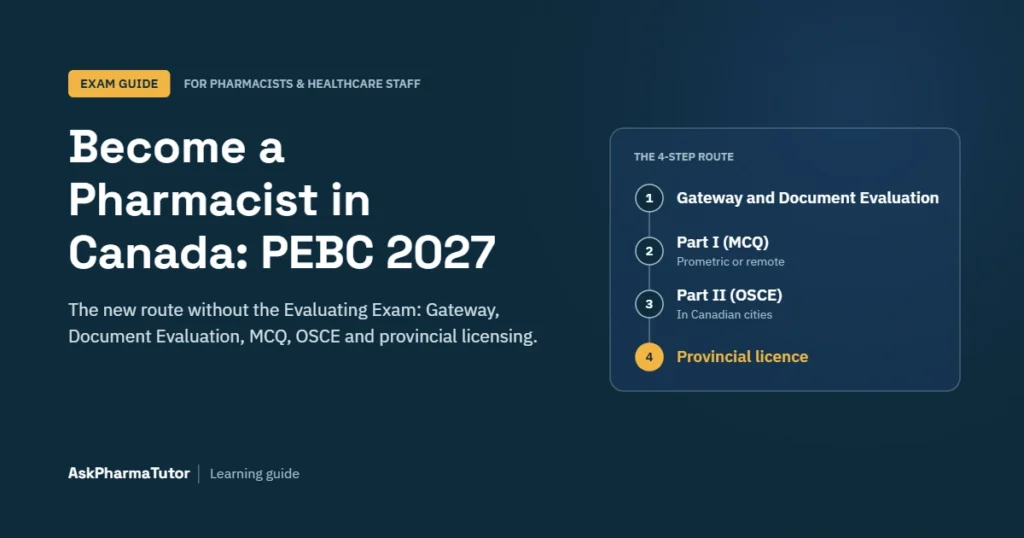
- The new route: enrol in Pharmacists’ Gateway Canada, pass PEBC Document Evaluation, then the Qualifying Examination Part I (MCQ), then Part II (OSCE).
- Your Document Evaluation is valid for five years, and you must pass Part I before you can apply for Part II. You have up to four attempts at each part.
- PEBC fees for one attempt at each step total CAD 3,535 (Document Evaluation CAD 715, Part I CAD 870, Part II CAD 1,950, 2027 fees).
- Part I can be taken at a Prometric centre or by remote proctoring, but Part II is held only in Canadian cities. PEBC certification is not a licence: your provincial regulator licenses you after its own requirements.
Many pharmacists choose Canada because it offers a route to settle permanently, and in January 2027 that route becomes shorter. The Pharmacy Examining Board of Canada (PEBC) is removing the Evaluating Examination for international pharmacy graduates (IPGs), so you go straight from document evaluation to the Qualifying Examination. This guide explains the new route step by step, using PEBC’s own pages: what changes, the 2027 exam dates, the fees, what each exam involves, and what your province will still ask for after PEBC.
What changes in January 2027
| Before (until October 2026) | From January 2027 | |
|---|---|---|
| Steps after Document Evaluation | Evaluating Examination, then Qualifying Examination | Straight to Qualifying Examination Part I (MCQ) |
| Order of the Qualifying Examination | After passing the Evaluating Exam, Part I and Part II in any order | Part I must be passed before you apply for Part II |
| Document Evaluation validity | Did not expire once the Evaluating Exam was passed | Valid for 5 years; once you pass Part I it stays valid for the rest of your pathway |
| If you used up Evaluating Exam attempts | Could not continue | You can continue under the new pathway with a valid Document Evaluation |
If you already passed the Evaluating Examination (including the June or October 2026 sittings), the change does not affect you: you can apply for Part I and Part II in any order.
Step by step: the new route to PEBC certification
1. Enrol in Pharmacists’ Gateway Canada
Every international pharmacy graduate must enrol in Pharmacists’ Gateway Canada, run by the National Association of Pharmacy Regulatory Authorities (NAPRA), before applying to PEBC. Gateway holds your documents in one place and shares them with PEBC and your chosen provincial regulator, and it is where you upload your language test results. Quebec has its own process through the Ordre des pharmaciens du Québec.
2. PEBC Document Evaluation
PEBC checks that your pharmacy degree and identity documents meet its requirements. The fee is CAD 715. Your Document Evaluation is valid for five years from approval; if you have not passed Part I within that time you must complete Document Re-evaluation. It must also be complete at least two business days before an exam’s application deadline, and it cannot be done that quickly, so start early.
3. Qualifying Examination Part I (MCQ)
A single-day, closed-book, computer-based exam. The sitting lasts 4 hours and 30 minutes. After you apply, PEBC emails an invitation to schedule no later than two weeks before the exam, and you choose a Prometric test centre or remote proctoring at home. The 2027 fee is CAD 870.
4. Qualifying Examination Part II (OSCE)
A practical, station-based exam in which you counsel simulated patients, solve drug therapy problems and deal with prescriptions, as you would in practice. It is held only in Canadian cities, such as Calgary, Edmonton, Halifax, Hamilton, Kingston, London, Ottawa, Toronto and Vancouver for February 2027, so you must travel to Canada for it. The 2027 fee is CAD 1,950.
5. Licensing with your province
PEBC certification does not let you practise on its own. Your provincial regulator licenses you after its own requirements, which typically include language proficiency, a jurisprudence (law and ethics) exam, structured practical training and a criminal record check. In Ontario, for example, the Ontario College of Pharmacists asks IPGs to complete an IPG education program, register as an intern, pass the Practice Assessment of Competence at Entry (PACE) and the Jurisprudence, Ethics and Professionalism exam. In British Columbia, IPGs complete structured practical training through the Canadian Pharmacy Practice Program and a jurisprudence exam. Check your province’s page on Gateway before you start.
2027 Qualifying Examination dates
| Sitting | Part I (MCQ) | Part II (OSCE) | Apply by (12 pm Eastern) |
|---|---|---|---|
| February 2027 | 10–12, 16–20, 22–25 February | Sunday 21 February | 19 November 2026 |
| May 2027 | 12–14, 17–21, 25–29, 31 May | Sunday 30 May | 18 February 2027 |
| July 2027 | 12–16, 19–23 July | Not offered (MCQ only) | 13 May 2027 |
| November 2027 | 1–5, 7–10, 12 November | Saturday 6 November | 5 August 2027 |
Because Part I must be passed before Part II, a realistic plan for a new candidate is Part I in one sitting and Part II in a later one. PEBC may change dates or cancel a location, so always check its Examination Dates and Fees page before you apply.
What it costs
| Item | Fee (CAD) |
|---|---|
| Document Evaluation | 715 |
| Qualifying Examination Part I (MCQ), 2027 | 870 |
| Qualifying Examination Part II (OSCE), 2027 | 1,950 |
| Total PEBC fees for one attempt at each | 3,535 |
| Re-scoring: Part I / Part II | 100 / 200 |
| Rescheduling or cancelling Part I (paid to Prometric) | 60 + HST |
On top of PEBC’s fees, budget for Gateway enrolment, a language test, travel to Canada and a visa for Part II, any bridging or IPG program, and your province’s application, exam and registration fees.
How to prepare for Part I
- Start with PEBC’s own Qualifying Examination blueprint, sample questions and sample examination, all free on its website.
- Build your study plan around clinical care and therapeutics, which carry the most weight in Part I, then drug distribution, dispensing and pharmacy practice.
- Learn Canadian practice context: the role of the pharmacist, prescribing and adaptation in your province, and Canadian drug names and guidelines.
- Practise full timed sessions of 4.5 hours so your concentration lasts the whole exam.
- For quick daily practice, use our free Pharmacology Quiz and Pharmaceutical Calculations Quiz.
Checklist for Pakistani pharmacists
- Pharm-D degree certificate and full transcripts, which PEBC may need to receive directly from your university
- Passport and other identity documents, with your name spelled the same everywhere
- An English language test accepted by your province (Ontario lists CELPIP, IELTS, OET and TEF Canada for French)
- Your Pharmacy Council registration, for your province’s licensing stage
- Savings for fees and travel, and a plan for a Canadian visa to sit Part II
Immigration is separate. PEBC and provincial regulators do not handle visas or permanent residence. Check Immigration, Refugees and Citizenship Canada (IRCC) for your options, or speak to a licensed immigration consultant before you pay large fees.
Frequently asked questions
Do I still need to take the PEBC Evaluating Exam?
No, if you are an international pharmacy graduate starting now. From January 2027 you go directly to Qualifying Examination Part I after a valid Document Evaluation. October 2026 was the last Evaluating Examination.
Can I take the PEBC exam in Pakistan?
Part I (MCQ) is delivered by Prometric at test centres or by remote proctoring, so check the test centre list when you schedule. Part II (OSCE) is held only in Canadian cities, so you must travel to Canada for it.
How many attempts do I get?
Up to four attempts at each of Part I and Part II. If you fail a part three times, PEBC requires remediation activities before your fourth attempt.
Is PEBC certification the same as a licence?
No. PEBC certifies that you meet the national standard. You become a licensed pharmacist only when your provincial regulator registers you after its own requirements.
I failed the Evaluating Exam four times. Can I continue?
Yes. PEBC says candidates who used up their Evaluating Exam attempts can continue under the new pathway, as long as their Document Evaluation is valid.
Related guides
- Working abroad as a pharmacist: every licensing route compared
- How to become a pharmacist in Australia: OPRA exam and registration
- How to become a pharmacist in the UK: OSPAP and GPhC
- How to become a pharmacist in the USA: FPGEC guide
References
- Pharmacy Examining Board of Canada. New Certification Pathway for International Pharmacy Graduates (IPGs) (updated 10 August 2026).
- Pharmacy Examining Board of Canada. International Pharmacy Graduate (IPG) Certification Pathway; Examination Dates and Fees; Qualifying Examination Part I and application information.
- National Association of Pharmacy Regulatory Authorities. Pharmacists’ Gateway Canada.
- Ontario College of Pharmacists. Registration steps for international pharmacy graduates; language proficiency requirements.
- College of Pharmacists of British Columbia. International pharmacy graduate registration.
This guide is for information. PEBC, NAPRA and provincial regulators set the requirements and can change dates and fees; always confirm on their websites before you apply or pay.
